A short-sighted decision to close the Saint Mary’s University language centre is inflicting long-term harm on members of CUPE 3912 and the international students they supported. Management at the Halifax-area university waged a campaign of cuts and neglect before abruptly shutting down the centre in 2024.
The centre provided a language bridging program where international students could study English in order to start academic programs at Saint Mary’s University (SMU). Instructors provided English language training as well as courses on academic communication, critical thinking, and research methods and standards.
Highly trained language instructors with decades of experience helped international students adapt to a different culture as they adjusted to campus life.
Replacing workers with an app
Management laid off the centre’s 22 instructors in the middle of a teaching day, while the local was in bargaining. CUPE 3912 president and language instructor Lauren McKenzie later learned that SMU would use Duolingo, an artificial intelligence (AI) language training app, for crucial language training and testing.
McKenzie is clear that Duolingo may have a role in education, but it is no substitute for a highly trained educator who understands the connections between language and culture, and can respond to a learner’s needs.
“AI is amazing, but it does not bring that exchange,” says McKenzie. “That is human-powered.”
Closure a major blow to students and workers
The language school closure is a major blow to international students and CUPE members. “We are all cast out now,” says McKenzie. “We don’t have CUPE work anymore. Our section has been dissolved.”
McKenzie says the laid off instructors are either out of work or working in private language schools for half the pay and no benefits. CUPE 3912 filed a grievance and was able to negotiate a package for affected members.
The local represents more than 5,000 workers in five bargaining units at four Halifax universities. Language instruction has also been cut back or eliminated at Dalhousie University and Mount Saint Vincent University. “We’re all precarious workers,” says McKenzie.
Exploiting international students
Over the years, McKenzie has seen SMU cut other services for international students like visa support, while exploiting them by charging high tuition fees.
Sarom Rho, coordinator of the international student section of the Migrant Workers Alliance for Change, agrees. “What we’re seeing is that these educational institutions are using these kinds of language programs as ways to recruit international students, charge a lot of money, which then goes to subsidizing public education,” Rho says.
“When they operate with the objective of supporting international students with language, which is such an essential tool that we use to feel a sense of belonging, a sense of homemaking, a sense of connection, then I think these programs are very good,” Rho adds.
Unfortunately, in recent years, contradictions have emerged with universities attempting to extract the maximum profit from international students while deteriorating programming.
International students have always been marginalized on university campuses, according to McKenzie. She has seen students denied university services like a gym membership or a bus pass, despite being full-time language centre students.
“It’s the ultimate corporatized university: treating workers as disposable and the students as the income unit,” she says.
The latest cut leaves McKenzie questioning how international students will access education at SMU. “They can get in, but how can they stay? It’s just throwing them to the wolves,” she adds.
Rho also states that language is a key component of the current points-based immigration system. International students need a very high score in order to qualify for the federally-managed immigration program. Language programs like SMU’s supported students in meeting these requirements.
Cuts on university campuses
SMU is not the only post-secondary institution to lose language programming for international students. The University of Saskatchewan, Simon Fraser University and the University of Winnipeg have all closed English language programs. George Brown College also announced it was ending its English for Academic Purposes course in 2026, a program that had been in place since 1969.
These closures are in part a response to the federal government’s decision to slash the number of study permits for international students after elected leaders and right-wing pundits unfairly blamed immigration and international students for the housing crisis. They were looking for a scapegoat rather than taking responsibility.
Language centre closures are just one part of a vast array of cuts to post-secondary education programs and services. Academic programs have closed, as well as counselling services and programs addressing gender-based violence. All of this occurs in the context of decades of government underfunding of post-secondary education in Canada. In the 1980s, the provincial and federal governments contributed 80% of total funding for colleges and universities. Today, they contribute barely 50%.
Organizing for the fights to come
These program cuts are happening alongside the most significant rollback to migrant rights in Canadian history. Over 200,000 post-graduate work permits for international students are set to expire by the end of 2025, and this will leave countless graduated students stranded, many of whom have already applied for permanent residency. These measures come in addition to broader changes affecting migrant workers, international students and refugees.
Workers are also affected by the rollbacks, and like other employers, post-secondary employers are using these immigration changes to fire CUPE members who are migrant workers. CUPE has been working with allies to protect and defend our members. Last year, our union launched a guide to support members who are temporary foreign workers. CUPE has been working with the Migrant Workers Alliance for Change to get the federal government to renew post-graduate work permits.
Rho points to the interconnections between our struggles: “Migrants are exploited, migrants are also fighting back against these types of systems, and so are unions.”
As for CUPE 3912, the local recently won a victory that will give workers a say in future decisions affecting members and students. Part-time faculty had fought for years for a seat on the Saint Mary’s University Senate. In May 2025, senators amended their bylaws to let part-time faculty run for a Senate seat, and vote for their own representative. CUPE 3912 is mounting similar challenges to university governance at the other universities where its members work. This will give the union more power to protect workers and students in the fights ahead.

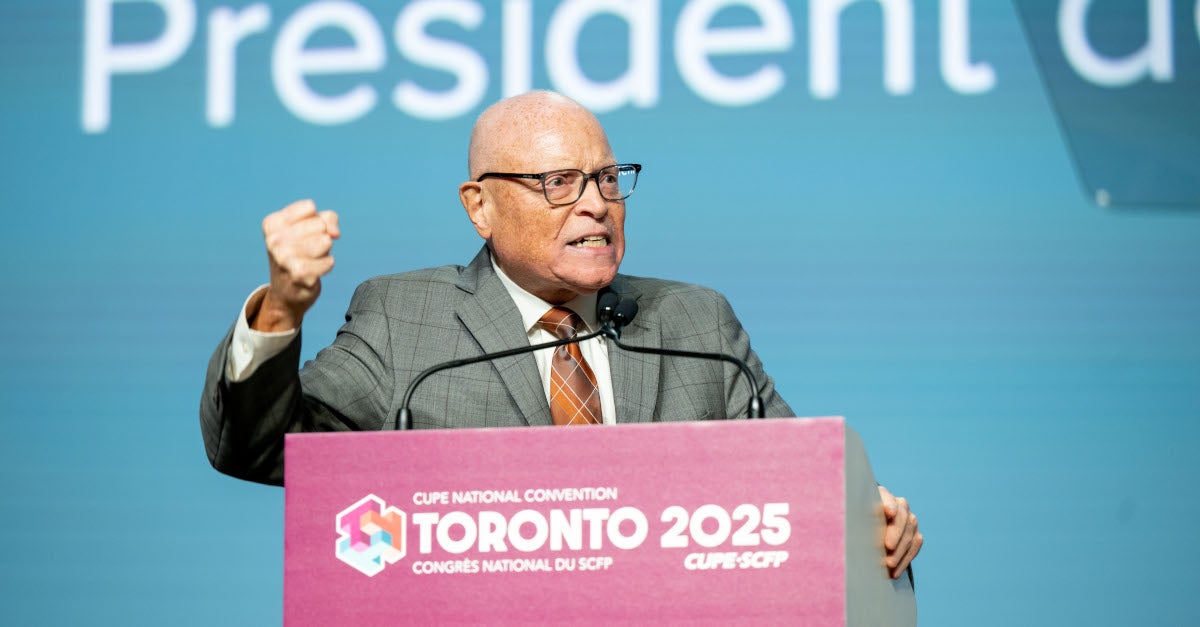
 Delegates re-elected Mark Hancock as National President and Candace Rennick as National Secretary-Treasurer at National Convention on Wednesday.