Press "Enter" to skip to content

Posts published in October 2025

Workers at University of Toronto Press and Bookstore set scene for a strike in Canada’s book publishing industry

The clock has been set for a potentially historic moment – a possible strike in the book publishing industry. Members of CUPE 3261 who work at the University of Toronto Press and Bookstore requested a “no board” report from the Ontario Labour Relations Board yesterday evening.

A strike or lockout is legal 17 days after a “no board” is issued. The application follows a strike vote that received more than 90% support.

“The issues here are no different that we see for warehouse and distribution or retail workers anywhere: The rising cost of living, instability faced by part-time workers, the need for decent health benefits and sick days.” said Luke Daccord, president of CUPE 3261. “Our goal is to reach a deal that provides more stability for the workers, allowing improved operations at UTP and the bookstore for publishers and retail customers.”

CUPE represents more than 100 warehouse and distribution staff at the University of Toronto Press, and retail staff at the University of Toronto Bookstore.

UTP is best known as an academic publisher, but it is also the leading distributor of academic titles in Canada and also distributes books for many small and mid-sized independent Canadian publishers.

The parties have agreed to continue negotiations on October 29. The workers are expected to be in a legal strike position in early November.

Community and social services workers demand for long-overdue justice from Ford Conservatives for Bill 124

More than 600 days since Bill 124 was repealed, tens of thousands of community and social services workers are still waiting for the wages that were stolen from them. With the return of the Ontario Legislature, workers are calling on Doug Ford’s Conservative government to finally deliver justice.

Bill 124, passed in 2019, capped wage increases for public sector workers at 1% per year, even as the cost of living soared. The law violated workers’ constitutionally protected collective bargaining rights, drove down wages, pushed workers into poverty, and deepened a province-wide crisis in community and social services.

“Bill 124 was found unconstitutional twice. It trampled on workers’ rights. It deprived our communities. Finally, it was repealed because workers fought back. But in the months since, Doug Ford’s Conservatives have paid back wages to some workers and continued to ignore the crisis they created in community and social services,” said Fred Hahn, president of CUPE Ontario.

“Social services workers are living in poverty despite doing some of the most critical care work in our communities. This has to end. Doug Ford does not get to pick winners and losers while short-changing families who depend on these services.”

Together, CUPE and OPSEU represent more than 50,000 workers across community agencies, developmental services, community health services, and children’s aid societies who never received Bill 124 remedy.

Workers from more than 60 agencies are leading the Worth Fighting For campaign to secure fair, funded wage increases and much needed long-term investments in frontline community and social services. More than 35 locals have already taken strike mandate votes with dozens planned in the weeks ahead. They are showing they are united as they take their fight to their collective funder – the Ford government – and they are willing to take coordinated action unless the province steps up.

“Workers cannot live off of these low wages and communities deserve better than years-long waitlists for support. We have workers moonlighting at second or third jobs and relying on food banks while families struggle to find mental health counselors for their children or developmental supports for their loved ones. That is a direct result of chronic underfunding and it is the reality in Doug Ford’s Ontario,” said JP Hornick, president of OPSEU/SEFPO. “These workers make an impact in every single community in this province. They deserve to catch up for the years of wages that were stolen from them. And our communities deserve long-term, stable funding for the community and social services we need.”

This Thursday, CUPE and OPSEU members will bring the Worth Fighting For campaign to Queen’s Park with a 9:30 AM press conference in the media gallery to take a stand for themselves and the communities they support, followed by a march through the downtown core.

Shelburne long term care workers vote to strike

Late last week, Roseway Manor long term care workers, represented by CUPE 3099, voted 100% in favour of a strike mandate citing low wages, understaffing, and lack of respect for support service workers who keep the long term care home running. 

“For years, the long term care sector has been struggling,” said CUPE 3099 President Holly Snow, “and Roseway is no different. We’re understaffed, constantly working short, and the low wages undermine any recruitment efforts.”

CUPE 3099 is the first of the fifty-two CUPE represented worksites to take a strike vote. Collectively, they are participating in lead table bargaining, which allows all workers to fight together for priority items such as wages, workplace safety, and staffing. 

“Across the province, long term care workers have been saying the same thing for years: they need help,” said CUPE Long Term Care Coordinator Tammy Martin. “The government has heard us, we talked to them directly, we went to the first sitting of the fall legislature, but they still refuse to take the problem seriously.”

In recent years, the Houston government has granted several contracts to private companies to build and run long term care facilities rather than investing in the existing public infrastructure in the province. These public-private contracts, known as P3s, promise to add hundreds of new beds to tackle the nearly 2,000-person wait list for long term care placements. However, this does nothing to address chronic understaffing caused by the worker shortage due to low wages and poor working conditions.

“More beds doesn’t mean less people on waitlists, it means more unused beds because we don’t have long term care workers to offer the care required. Already less than half of the current long term care homes can manage the recommended 4.1 hours of care per resident per day—how will adding more beds without changing the circumstances of the workers solve that issue?” asked Martin.

“We may only be one long term care home, but we’re not alone. We’re joined by our fellow long term care workers across the province who have reached their breaking points. Our issues are universal in the long term care sector and we can’t go on like this. We won’t,” finished Snow. 

CUPE welcomes NDP bill to ban unpaid work for flight attendants

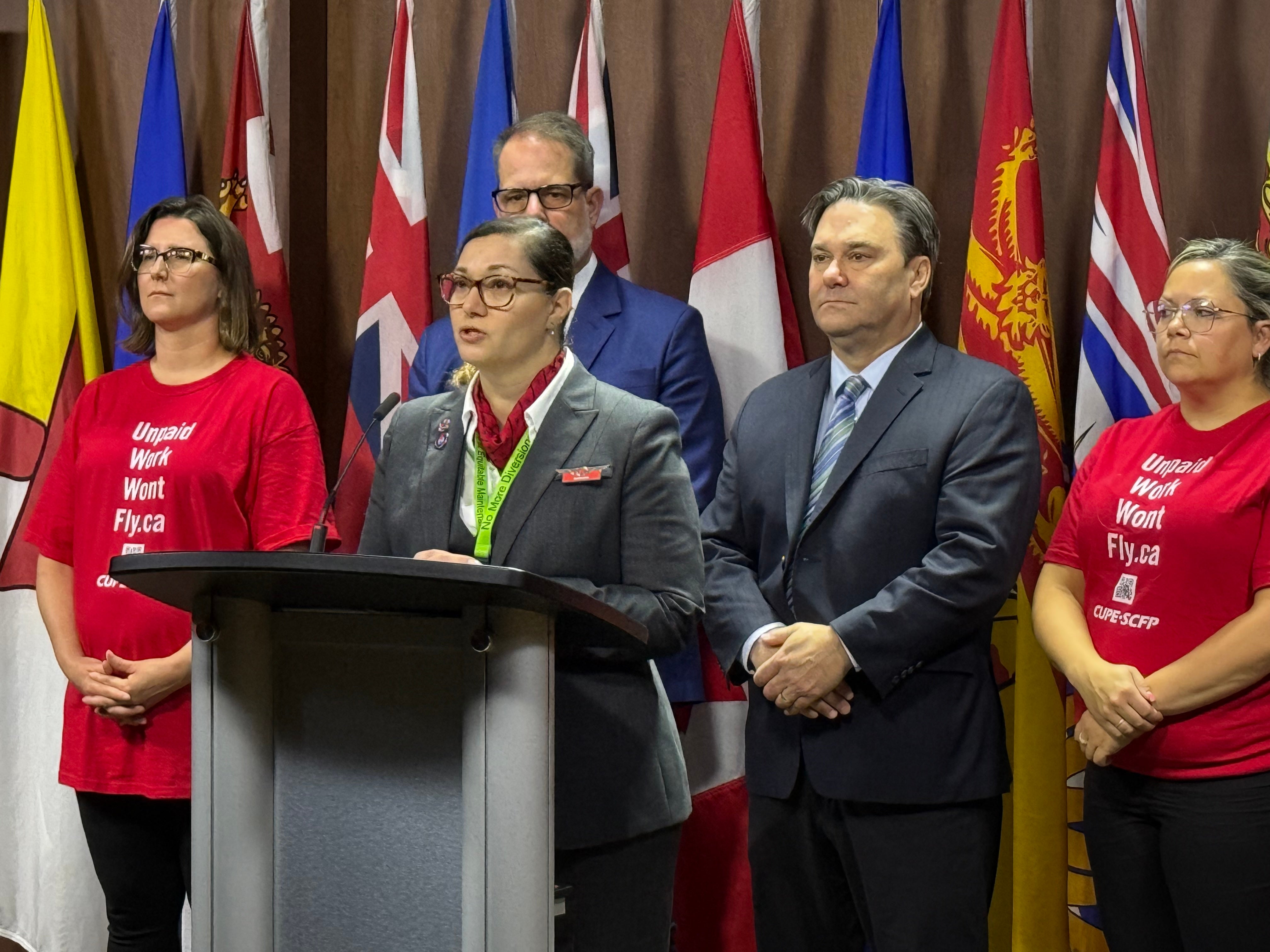
Flight attendants across Canada represented by CUPE are welcoming new legislation from the federal NDP that will finally make it illegal for airlines to force flight attendants to perform countless hours of work for free every month.

The private members bill, introduced by interim NDP leader Don Davies, would amend the Canada Labour Code to ensure flight attendants are paid at their full negotiated hourly rate, for all duties, including pre-flight, post-flight, and training.

Currently, flight attendants in Canada perform 35 hours of unpaid work every month, on average. Those unpaid duties include vital safety-related tasks during the boarding and deplaning process, as well as pre-flight safety checks and attending to medical and safety emergencies on the ground.

“This is about fairness and respect,” said Natasha Stea, president of CUPE 4091 representing Air Canada flight attendants based in Montreal, who was on hand for the announcement. “For years, flight attendants have been expected to work for free during boarding, delays, and deplaning, all while ensuring passenger safety. It’s time the law caught up with reality: all work deserves to be paid.”

This summer’s historic Air Canada flight attendant strike brought national attention to the issue of unpaid work. Despite being among the most profitable corporations in the country, Air Canada and other major carriers still rely on unpaid labour for essential parts of flight attendants’ duties.

“Workers should not have to negotiate for the right to be paid while they’re at work. It should be the minimum standard and the law of the land,” Stea continued.

“This is not a partisan issue; nine in ten Canadians agree that unpaid work needs to end,” said Stea, calling on all parties to pass the bill into law quickly. “Support this bill, and stand on the right side of history.”

CUPE is Canada’s flight attendant union, representing 20,000 cabin crew at 11 airlines across Canada.

Provincial Bargaining Bulletin #6 – Bargaining continues for Provincial Framework Agreement

CUPE K-12 Banner

Your K-12 sector provincial bargaining committee was back at the negotiation table late last week for our 5th session with the B.C. Public Schools Employers’ Association (BCPSEA).

Over the 2 days of meetings, we continued making progress on violence in our workplaces. This is one of our key priorities for this round of bargaining. While there is still a lot of work to do, your bargaining committee is cautiously encouraged with progress that was made on this critical issue.

We know from previous rounds of Provincial Framework Agreement negotiations that collective bargaining is a process. Your bargaining committee is making progress at the table to getting us to our ultimate goal—a fair collective agreement that acknowledges the vital role our members play in our public education system and addresses the challenges we are all facing with rising costs and unsustainable workloads.

Your support is crucial in our success. Your bargaining committee greatly appreciates your engagement in your locals, and the many messages of encouragement being sent through social media. If you have not already done so, please follows us @CUPEK12BC on Facebook, and make sure your contract information is up to date with your local to continue receiving bargaining updates.

View PDF