
Press "Enter" to skip to content

Posts published in December 2025

What does Budget 2025 mean for Canada?

On November 4, the new Liberal government tabled its first budget in the House of Commons. The nearly 500-page document lays out Mark Carney’s plan to supposedly “build Canada strong” in a time of profound political and economic transformation. Yet a closer look shows a short-sighted, inadequate and destructive plan that misses the mark in every area where it counts.

Soon after Carney was elected, the government announced that almost all government departments would be required to cut 15% of their budgets by 2028/29. Budget 2025 outlines what that will look like: staff cuts that will put 40,000 public servants out of work over the next four years, as well as cuts to programs and departmental transfer payments. These cuts will place further strain on the delivery of important government services.

The budget includes no plans or funding to further develop programs like pharmacare, dental care and child care. It leaves major funding and policy gaps in EI, health care, child care, and long-term care, and prioritizes the demands of corporate lobbyists. The budget embraces artificial intelligence, fossil fuels and military spending in a way that gives huge benefits to American business interests. Carney promised transformative change, but gave us tweaks and half measures at best.

Since his election campaign, Carney has been repeating the slogan “spending less to invest more.” This catchphrase is exemplified by a new federal budgeting process called the “Capital Budgeting Framework.” This new framework separates government spending into two categories: operational spending and capital investment.

Operational spending includes the kind of spending that most people would associate with the government: transfers to individuals, funding provided to provinces for health and social programs, and the costs of running government operations and services, including salaries and benefits.

The second category, capital investment, is a bit more complicated. In the broadest terms, it includes any government spending or initiatives that build Canada’s “capital stock” – meaning assets such as roads and bridges, mines and pipelines, machinery, and buildings ranging from factories to hospitals; the kinds of investments that are expected to encourage economic growth.

In the current budget, capital investment also includes things like tax breaks aimed at attracting business investment in Canada, and other efforts to make Canada’s economy more “competitive,” including by weakening our climate strategy or blindly embracing artificial intelligence.

Under the new capital budgeting framework, subsidies to fossil fuel executives, real estate developers and other big business owners are presented to the Canadian public as investments that will benefit the rest of us in the long run. However, the numbers just don’t add up.

In the weeks leading up to budget day, Mark Carney promised that his government would “balance the operating budget in three years’ time” — a misguided priority with a hidden cost that we exposed in the Fall 2025 edition of Economy at Work. The new capital investment distinction is how Carney plans to “balance the budget,” by balancing operational spending through cuts, and creating a capital investment deficit by subsidizing billionaires.

The problem with this plan is that it overlooks the importance of operational spending and overstates the economic benefits of capital investment for working people. By focussing its spending priorities on building infrastructure and attracting business investment, the government reduces its capacity to invest in workers and high-quality public services. For example, the new budget focus on how capital investment might allow a province to build a new hospital, in partnership with a private development company. But with no increase in operational spending, there might be no funding to hire more health care workers to staff it.

As previously mentioned, Carney’s Liberals do not consider the Canada Health Transfer and Canada Social Transfer, funding that is transferred to provinces and territories for health care and social programs, to be investments within their new framework. It’s not surprising, then, that Budget 2025 ignores repeated calls to address the strain on health care, social services and education by increasing transfer payments, which are not keeping up with inflation or population growth.

Perhaps the only impressive thing about Carney’s plan in Budget 2025 is that it finds a way to increase government spending in a way that has sent the Conservatives into a frenzy, while delivering massive cuts to government programs, and not investing any new money into areas where working families need it the most.
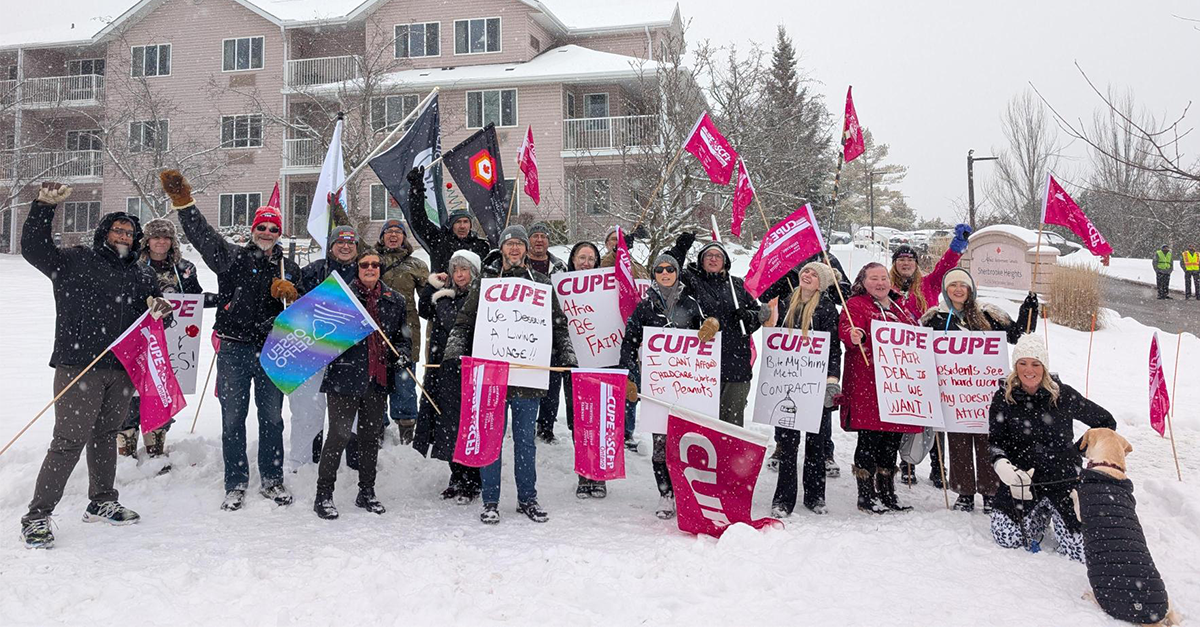
CUPE 5129 holds solidarity rally as talks resume

People holding flags The members of CUPE 5129 held a solidarity rally on Sunday, December the 7th outside Sherbrooke Heights in Peterborough. Members of the Peterborough labour community  joined CUPE 5129 members to send a message to Atira Retirement Canada that threats and intimidation won’t break their resolve, and that the only path forward is a fair wage offer.

“The living wage in Peterborough for 2025 is $22.20 an hour,” said Heather Blackburn, president of CUPE 5129. “The offer the employer made wouldn’t even reach that for most of our members by 2027. We have families to feed, bills to pay. We need an offer that respects our needs.”

The union has been in negotiations with Atira since the spring. Talks broke down after the Atira failed to provide a wage offer that meets the pattern within the sector in Ontario. The parties are working with a conciliator to try and reach a deal before the deadline on December 15th. The union is hopeful that the employer will return to the table with a wage offer that respects the services the workers provide.

Town of Grand Falls-Windsor terminates CUPE 1349 President for participating in Elections

CUPE Newfoundland and Labrador President Sherry Hillier is calling out the town of Grand Falls-Windsor today for terminating a long-standing employee for executing her right as a Canadian taxpayer to participate in local elections. This move follows the local issuing their notice to bargain.

“Every citizen of Grand Falls-Windsor has the right to participate in and comment on local elections. Working for the town doesn’t suddenly take away that right,” said Hillier. “It’s absolutely shameful the town would use such an excuse to fire one of their employees and the local union president—and that’s just what it is: an excuse.”

CUPE will fight this termination by filing a grievance to arbitration for an unjust termination.

Black History Month 2026: Honouring Carol Wall

Carol Wall was a fearless Black feminist, trade unionist and anti-racist activist. Her leadership transformed the Canadian labour movement and had a profound impact on our union.

From her early days at the Toronto Star, where she spent years organizing and advocating through the Southern Ontario Newspaper Guild, to her national roles in later years, Carol’s commitment to equality and workers’ rights never wavered.

Breaking ground on pay equity

Carol was a founding member of the Coalition of Black Trade Unionists and one of the first Black women activists in Ontario to challenge race-based wage discrimination. 

Carol insisted we could expose racism in pay structures simply by looking at the people doing the lowest-paid jobs in our workplaces, often Black and racialized workers.

She worked with CUPE and the Ontario Federation of Labour to challenge job evaluation systems. At the time, these systems undervalued work typically done by racialized women and painted the low pay as “market realities,” masking institutional racism. Her decades of advocacy led to race-based discrimination being recognized in a landmark 2004 federal pay equity report.

Leaving her mark on CUPE

Carol had a profound impact on our union. She helped develop CUPE Ontario’s Anti-Racism Organizational Action Plan to break down barriers and create a stronger, more inclusive union.

A seasoned labour educator, Carol was also deeply involved in launching Women in Leadership (WILD). This radical program supports Indigenous, Black, and racialized CUPE women to be, as Carol put it, “the creative and courageous leaders the movement needs.”

Inspiring the next generation

As the Communications, Energy and Paperworkers Union’s first human rights director, she worked to unite equity-deserving members and strengthen human rights across the labour movement.

Her leadership continued at the Canadian Labour Congress, where she worked on women’s rights and was a member of the CLC’s human rights committee. In 2002, she was elected to the CLC executive council as a vice president representing workers of colour.

Carol’s historic 2005 campaign for CLC president inspired a new generation of activists demanding a bold, inclusive, and militant labour movement.

Carol later worked as a negotiator with the Public Service Alliance of Canada before joining the Federal Mediation and Conciliation Service, where she became the first Black woman to serve as Ontario director.

Sadly, Carol left this world in April 2023. She is survived by her three children, her husband and her grandchildren, all of whom loved her dearly.  Carol’s legacy lives on in our ongoing fights for justice.

UCP fails Deborah Onwu, care workers

With the fall session of the Alberta Legislature set to end next week, it’s obvious that the United Conservative government will not be bringing in legislation called for in the judicial inquiry into a Calgary care worker’s death.

In October 2019, Deborah Onwu, an employee of Woods Homes Society, was stabbed 19 times while working alone with Brandon Newman – then a resident of the society. Newman had complex needs, a history of violence, and assorted cognitive and mental health issues. Onwu, who was an experienced and highly trained counsellor, was working alone at the time and did not know Newman’s full history of violence.

Following the death of Onwu, the Canadian Union of Public Employees (CUPE) requested a fatality inquiry. The inquiry released four recommendations on September 18th, calling for legislative changes that would make care workers safer.

CUPE Alberta President Raj Uppal says the lack of action by the UCP government is heartbreaking.

“When Deborah was killed, her employer was following all the required laws and regulations, but they weren’t enough,” said Uppal. “That’s why Justice Jivraj made four recommendations that would protect workers – but the UCP seem ready to ignore them and hope the report gathers dust.”

Uppal says CUPE will keep pushing for changes to support care workers.

“We have draft legislation that the government can introduce today. The issue has been studied and re-studied. The UCP needs to act before more care workers lose their lives.”