
Press "Enter" to skip to content

Posts published in February 2026

Indigenous, Black, and racialized CUPE women and non-binary members: are you ready for WILD?!

Applications are now open for the first ever national Women in Leadership Development program

Illustration of various women and gender diverse people with flowers and an orange backgroundOur time is now! Break barriers and dive into leadership in our union and our communities.

Women in Leadership Development (WILD) is a feminist leadership and skills-building union education program designed for Indigenous, Black, and racialized women and non-binary members of CUPE.

WILD is designed to support you as you strengthen your skills in feminist leadership, thinking and acting strategically, communicating with confidence, taking risks, and building relationships across regions and sectors. The program begins with your lived experience, uses collective learning and will encourage you to step into leadership in ways that feel authentic and sustainable. Together we will build capacity and help you become the creative and courageous leaders our movement needs!

WILD began as part of the Anti-racism Organizational Action Plan of CUPE Ontario in 2022. In 2025, National Secretary-Treasurer Candace Rennick announced that WILD would become a national program. And that time has COME!

If you are a CUPE member in good standing and you answered yes to the questions below, we welcome you to apply!

  • Do you have lived experience as an Indigenous, Black, or racialized woman or non-binary person?
  • Are you new to activism or do you have leadership experience?
  • Do you want to make a difference in your community?

About the program:

  • An online orientation session
  • Two in-person weeklong sessions
  • A mix of in-person and online learning sessions (1-2 days)
  • One-on-one and group mentorship
  • Development of an innovative leadership project
  • Lifetime connections!

For more information and to apply, please click on the link for your region.

Long-term care in Nova scotia is dying, and Premier Houston is letting it happen

President of CUPE Nova Scotia Alan Linkletter sent a letter to Premier Houston last week calling on this conservative government to stop ignoring the hardworking long-term care workers of this province and offer them a fair deal instead of lining the pockets of private companies.

“Since Houston entered office, we have been overrun with examples of his government offering up millions of dollars in contracts to private companies instead of using that same money to invest in strengthening the already existing public services,” said Linkletter. “We’ve seen this impact bargaining over and over and now, as long-term care workers move closer to a strike, we’re seeing it again.”

CUPE-represented long-term care workers have been working without a contract since 2023 and, despite repeated attempts to bargain a fair deal, the government has tabled the same offer four times. This offer, which amounts to only a few dollars over four years for the majority, leaves these workers several dollars behind both the rest of Atlantic Canada and the living wage in Nova Scotia.

“Presenting the same offer over and over isn’t bargaining to me,” critiqued Linkletter, “that’s the government trying to force these workers to take a deal they decided on themselves months ago without listening to the workers and what they need.”

“I know, as the government announces more cuts to public service jobs and prepares what will in all likelihood be an austerity budget, the argument will be that this government can’t afford to pay these workers more. That’s simply not a sound argument. They had money to pay millions to private companies, to pay exorbitant salaries to their friends and personal connections. The government can, and does, find the money when they want to. They simply don’t want to, not for these workers,” finished Linkletter.

The full letter is available here: https://novascotia.cupe.ca/2026/02/20/open-letter-ltc/ ‎

Dalhousie’s part-time architecture faculty join CUPE 3912

CUPE 3912 is pleased to announce that part-time faculty in the Architecture Department at Dalhousie University (Dal) are officially members of the local as of January 14, 2026, retroactive to November 2025.

Architecture was one of only four departments at Dalhousie previously exempted from the part-time faculty collective agreement. With this change, only part-time faculty in computer science, engineering, and law remain outside the bargaining unit.

This move brings part-time architecture faculty working conditions into alignment with standards at architecture programs across Canada. Instructors will now enjoy improved compensation, a standard hiring practice, and have their seniority recognized.

CUPE 3912 members voted to welcome the group into the local in November 2025. An amendment of certification was subsequently filed with the Nova Scotia Labour Relations Board and was unopposed by Dalhousie University. The Board ruled to include the architecture part-time faculty in CUPE 3912 several months earlier than expected.

Motivated by the uncertainty created by the Dalhousie Faculty Association lockout last fall, the architecture part-time academics completed their organizing campaign within a single academic term.

CUPE 3912 represents approximately 300 part-time faculty at Dalhousie University. Larissa Atkison, Dal VP for part-time academics with CUPE 3912, welcomed the decision. “Our unit is thrilled to welcome Architecture part-time academics into the Local and looks forward to ensuring they receive the same protections and support as other part-time academic members on campus,” said Atkison.

CUPE 3912’s most recent collective agreement was bargained in October 2025. 

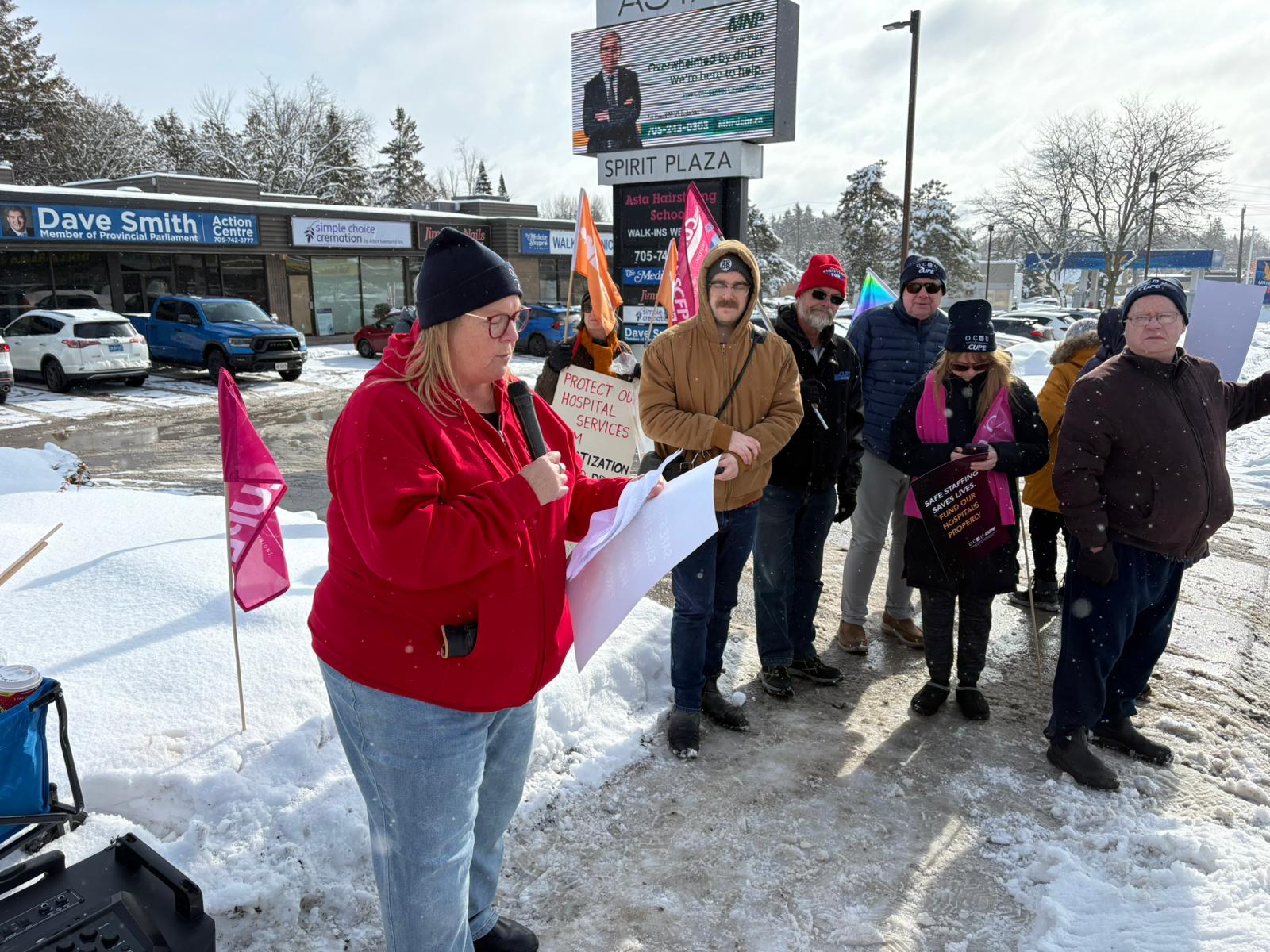
Health care workers protest outside MPP Dave Smith’s office as funding cuts take toll on staff, patients

Health care workers represented by CUPE held a rally outside local Ontario PC MPP Dave Smith’s office in Peterborough in response to funding cuts by the provincial government.

The government’s fall economic statement shows a plan to cut hospital funding by 10 per cent in real terms over three years by 2027-28 as projected spending fails to cover the six per cent annual cost inflation for hospitals, says CUPE.

The consequences of fiscal restraint are already being felt by staff and patients in hospitals across Ontario, as hundreds of jobs are being eliminated in North Bay, Hamilton, Ottawa, Niagara and the GTA as most hospitals face deficits and are cutting back on patient care.

“This government promised to clear surgical waiting lists and to end hallway medicine. 200,000 people are waiting for surgeries, and 73,000 patients are waiting longer than clinically recommended. 2,000 are on hallway stretchers waiting for beds and the government has now announced it will no longer report those numbers,” said Michael Hurley, president of CUPE’s Ontario Council of Hospital Unions (OCHU-CUPE), which represents 45,000 health care workers. “The PC funding plan through to 2027-28 will have devastating consequences for many people needing hospital treatment in Ontario.”

In Peterborough, about 115 nurses and PSWs could lose their jobs across the health care system by 2027-28 if the government doesn’t increase funding. CUPE estimates that the Peterborough Regional Health Centre would lose about 32 staffed beds, at a time when both staffing and capacity should be increasing in line with the needs of an ageing and growing population. The estimates are based on projections by the Financial Accountability Office of Ontario.

“Patients are not receiving the care they deserve in our hospitals,” said Sharon Richer, secretary-treasurer of OCHU-CUPE. “Health care workers are stretched to their limits trying to provide the best care possible, but they need more support in the form of safe staffing levels, manageable workloads, and a properly funded hospital system.”

The union is recommending the following actions by the provincial government:

  • In the short term, add 6,200 staffed beds to get patients off hallway stretchers, allow for aging and population growth and clear the backlog of people waiting for surgeries.
      
  • Increase core hospital funding by $3.2 billion to clear deficits and hire additional staff
      
  • Fund hospitals at their real costs (six per cent per year) with a multi-year funding commitment.

Carney government offloading health care costs to vulnerable refugees

The first federal budget delivered by the Carney government announced significant cuts to services provided by Immigration Refugees and Citizenship Canada (IRCC).

Starting in May of this year, resettled refugees and asylum claimants will have to pay part of the costs of services like emergency dental care, prescription drugs, and incontinence and diabetic supplies.

The government’s goal is to cut the amount it pays to private insurer Medavie Blue Cross to insure vulnerable people who are not eligible for provincial or territorial programs. By forcing these copayments, it expects to save $358M in the next two years.

What is the Interim Federal Health Program?

Refugees and refugee claimants are not eligible for provincial and territorial health insurance and social assistance programs. Refugee claimants cannot access any provincial health care or social assistance plans while they wait for a determination on their case—which may take years. Approved refugees may have to wait three months before they can access health care, and a year before they can access social assistance programs.

The Interim Federal Health Program (IFHP) is a federal plan to provide them with essential services while their residency status is resolved. It provides health coverage comparable to provincial and territorial health insurance and social assistance plans. The changes announced by the Carney government will require refugees and refugee claimants to pay 30% of the costs of supplemental coverage and a $4 prescription drugs copayment.

The impact of cutting health care coverage

Refugee claimants do not generally have savings or stable incomes. Although they can apply for a work permit, such permits are not guaranteed. When they are allowed to work, refugee claimants often navigate language and employment barriers that make it difficult to find well-paying jobs. They also face multiple expenses related to the uncertainty of their residency status: immigration lawyers, application fees, professional certification fees, and language training, among others.

These cuts to the IFHP will cause unnecessary suffering. It is unlikely that refugees and refugee claimants will find $358M to make the copayments. As a CCPA blog recently put it, they are more likely to avoid treatment for dental issues, and neglect prescriptions, hearing aids and diabetes supplies. These cuts will translate into additional barriers to employment and likely worse health outcomes, both of which will be more expensive in the long term.

Cost cutting costs more

It is true that the cost of the program has increased over the last few years. However, this is not due to refugee claimants receiving expensive services, as Conservative and Bloc politicians have insinuated. In fact, the IFHP’s annual costs per person is “well below” the cost of healthcare for the average Canadian on a provincial public plan.

Instead, the increased costs are the result of federal failure to process claims. Refugee claimants can wait years for a determination, meaning they are accessing the IFHP for longer. And as the backlog of claims grows, more people are added to the program.

The federal government could direct more resources to clear up the backlog, but it is instead cutting the workforce that processes refugee claims. In the absence of adequate processing capacity, the number of people using the federal program, and the length of time they use it for, will increase. The severity of health issues to be covered may also increase if people cannot afford timely care. All of these will result in more, rather than less federal expense.

Taking a wrecking ball to the system

As the Carney government is planning to transfer health care costs to refugees and cut processing capacity, it is also proposing sweeping immigration changes that undermine the rights and protections of migrants and refugees. And it is doing so under the guise of national security. 

Bill C-12, the Strengthening Canada’s Immigration System and Borders Act, will severely limit the ability of people to claim asylum in Canada. It will, for example, force asylum seekers to make a claim within one year of arriving in Canada. International students and temporary residents living in Canada may not be able to claim asylum if there are urgent or dangerous changes in their home country or country of origin more than a year after their arrival.

No one can predict when a war, genocide or climate crises will arise. Limiting asylum claims to one year after entering Canada, including retroactively, is detached from reality and cruel. It is also a violation of international law. These changes and others will undermine the integrity and fairness of the refugee system.