The more people that sign the petition the harder it will be for toront CAS and the Ontario government to ignore our call for safe staffing levels at Toronto CAS.
CUPE 2316 members thank you for joining their fight for safe staffing.

The more people that sign the petition the harder it will be for toront CAS and the Ontario government to ignore our call for safe staffing levels at Toronto CAS.
CUPE 2316 members thank you for joining their fight for safe staffing.
Years of provincial government underfunding have hollowed out child welfare services across Ontario. At the same time, CAS Toronto is refusing to fight for the funding we need to be able to do our jobs.
The result is a system pushed to the brink.
CAS Toronto cannot continue to ignore unsafe staffing levels, and the provincial government cannot continue to underfund child welfare. Children and families are paying the price for these decisions.
This is a call for accountability.
The current situation at CAS Toronto is unsustainable, and CUPE 2316 members are close to a strike.
Take action now, and tell CAS Toronto to take action to address staffing levels, and do their part to advocate for increased funding from the provincial government.
 A devastating report published by analyst Jean-François Blain for the Union des consommateurs shows that Hydro-Québec’s Action Plan 2035 could have a major impact on rates for all clienteles. The study reveals that rates could climb 29% by 2030 and 63% by 2035, which is a yearly increase of 7%.
As a result of $180 billion in distribution and production investments over 10 years, sales are expected to increase by 55 TWh in 11 years, even though demand has only risen by 11.3 TWh over the past 20 years. Resigning Premier of Quebec François Legault and his acolyte Pierre Fitzgibbon had hedged their economic bets on the battery subsidiary and electrification, but this industry has yet to get off the ground and is unlikely to deliver the goods.
“Where is Jean Boulet, who is now the Minister of Economy, Energy and Innovation? How about he explain this fiasco to people!” said Pierre-Guy Sylvestre, an economist with CUPE Québec. “While the aspiring interim premier is gallivanting around Quebec talking nonsense about the third link, Fitzgibbon is peddling hydroelectric dams to foreign interests. It’s shameful!”
Without a real plan to drastically reduce oil and gas consumption, how could the government have pushed our Crown corporation to take such a risk?
Neither its integrated energy resources management plan (PGIRE) nor its 2030 green economy plan (PEV 2030) will lead to a fair and sustainable economic transition. This administration has jeopardized Quebec’s prized organization and an extraordinary lever for development by making people believe it was shifting to a sustainable, vigorous and stable economy.
With the announced 6,000 MW of wind power to be developed through public-private partnerships, in addition to the 4,000 MW that has already been built, Quebec will soon be generating 25% of its electricity with private sources. The government has forced our Crown corporation to become a private-sector contractor, on Quebecers’ dime.
“Legault and his party are no longer credible; they must leave,” Sylvestre concluded. “It’s their mess and taxpayers shouldn’t have to pay to clean it up.”

Your bargaining committee met with the employer today for a pivotal meeting towards K-12 school support workers getting the deal we deserve.
We are pleased to report that the BC Public School Employers’ Association (BCPSEA) committee tabled a revised monetary offer. There is still considerable work to be done to get a provincial framework agreement, but your bargaining committee believes there is a path towards a fair deal. We are working with the employer on securing more dates to get back to the table. Members will be updated as soon as the next session is scheduled.
While the bargaining committee is optimistic, we are not at the finish line yet. It is very clear that the employer and the provincial government have seen that school support workers are united and we are all ready to do what it takes to get a fair deal. So, until we have that deal, we will keep the pressure on.
It has proven to be a long and tough round of bargaining, but the encouragement and support of members has been a great source of energy and inspiration for the bargaining committee.
Together we will get our deal.
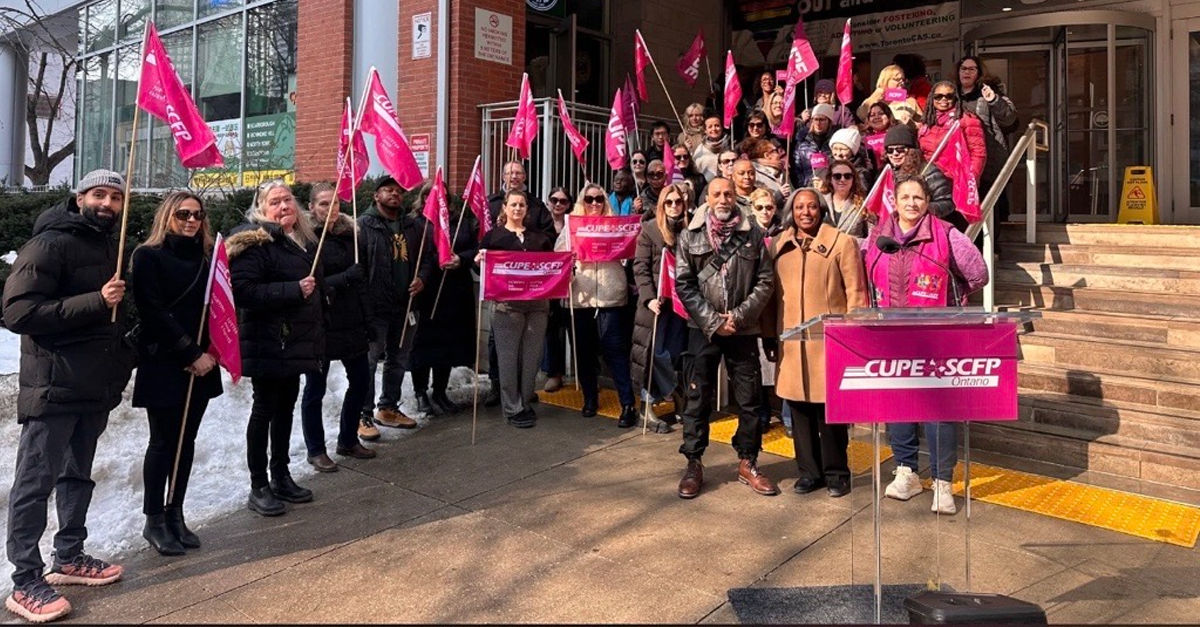 CUPE 2316, representing workers at the Children’s Aid Society of Toronto, are officially in a legal strike position as negotiations between the union and the employer have not led to an agreement and workers warn that a broader provincial funding crisis is pushing child welfare services to the brink.
Frontline and support staff say chronic understaffing, rising case complexity, growing service demands, and deep program cuts are preventing them from consistently meeting standards under the Child, Youth and Family Services Act.
“Our members have reached a breaking point,” said Aubrey Gonsalves, president of CUPE 2316, representing nearly 500 workers at CAS Toronto. “Workers are being asked to do more with less while services are cut. When staffing levels are dangerously low and prevention programs disappear, children and families are the ones who suffer. We do not take the possibility of a strike lightly, but we cannot ignore the risk these conditions are creating.”
CUPE 2316 recently issued a formal warning to CAS Toronto that burnout and workload pressures are creating critical gaps in service delivery. Worker’s report having less time to spend with families, covering additional duty shifts due to staffing shortages, and navigating increasing administrative demands while community-based mental health, developmental, and autism services remain inaccessible or underfunded.
CUPE Ontario says the crisis extends far beyond Toronto.
“What is happening at CAS Toronto is not isolated—it is part of a province-wide pattern,” said Yolanda McLean, Secretary-Treasurer of CUPE Ontario. “Across Ontario, child welfare agencies are struggling with chronic underfunding. Caseloads are rising, prevention is shrinking, and recruitment and retention are becoming nearly impossible. The Ford government has been warned for years, and yet funding has not kept pace with need.”
The union argues that agencies are being forced to operate within funding models that no longer reflect the complexity of today’s child welfare environment.
“When you underfund prevention, you guarantee crisis,” McLean said. “Children staying in care longer, families pulled into the system unnecessarily, workers burning out—these are the real-world consequences of political decisions.”
CUPE 2316 says the employer has refused to meaningfully address unsafe staffing levels at the bargaining table, while pointing to provincial funding pressures.
“CAS Toronto cannot bargain its way out of a funding crisis,” said Gonsalves. “But they can choose to prioritize staffing and safety. And the provincial government must step up with immediate, sustained funding increases so agencies can do the work the law requires.”
Now in a legal strike position, both CUPE 2316 and CUPE Ontario are calling on the provincial government to immediately increase child welfare funding and on CAS Toronto to return to the table with proposals that address staffing and service delivery.
“This is a wake-up call,” McLean said. “Children’s safety should never be collateral damage in a budget decision. The government must act now to stabilize child welfare before more harm is done.”