
Press "Enter" to skip to content

Posts published in February 2026

Solidarity with the Cuban people

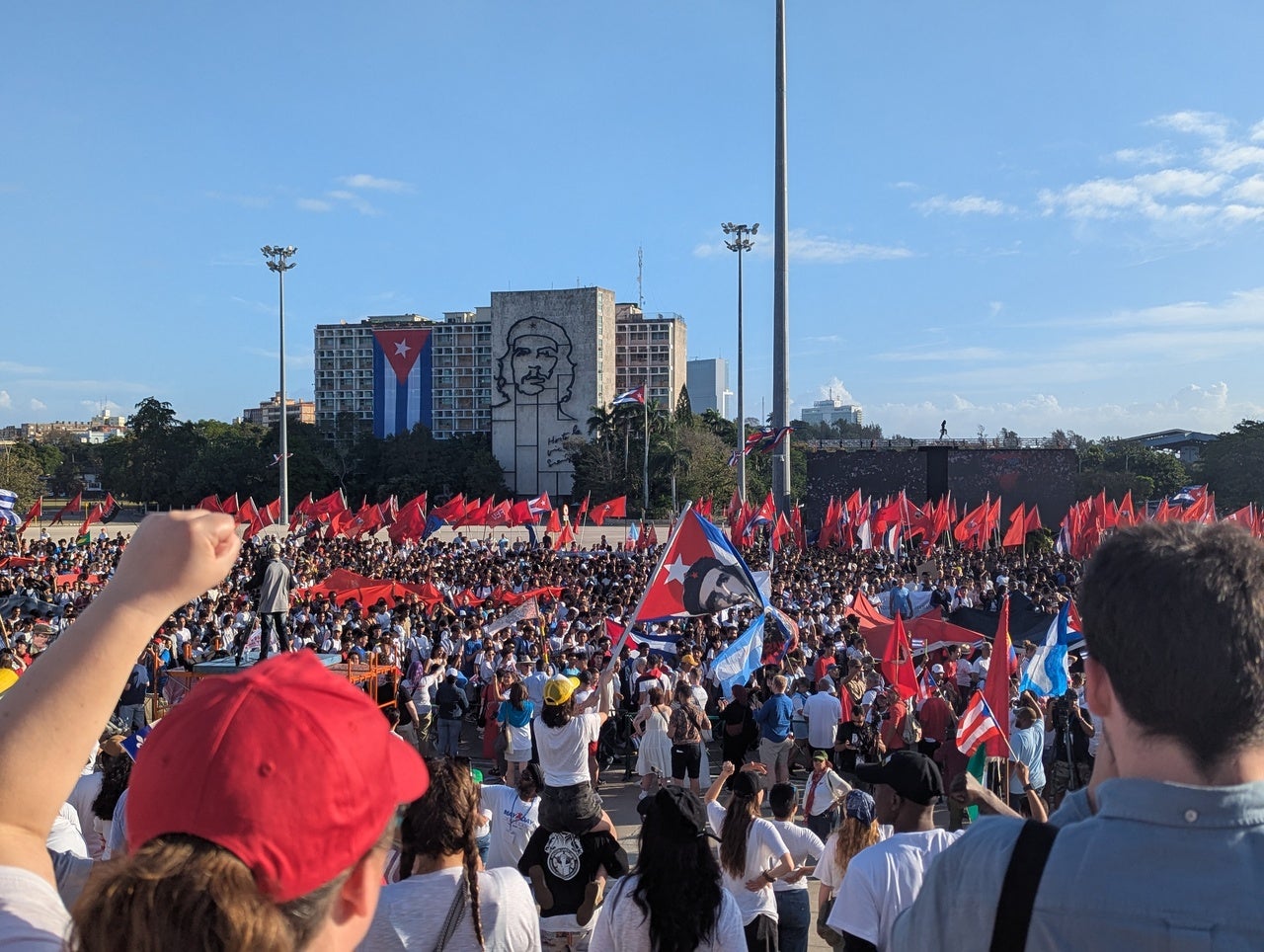
CUPE delegation joined 5 million Cubans for the International Workers’ Day march on May 1, 2025
CUPE stands in solidarity with the Cuban people and the trade union movement as the country grapples with intensified U.S. sanctions and a dangerous fuel shortage. We support the Cuban people’s sovereignty and their right to self determination. 
 

Cubans are suffering. For more than 60 years, an illegal U.S. embargo has caused daily hardship and scarcity in Cuba, blocking medicine, fuel and other essentials for daily life. During his first term, U.S. President Donald Trump listed Cuba as a state sponsor of terrorism. This deepened restrictions, leading to an extra 240 sanctions in 2021.

Venezuela’s state-run oil company provided Cuba with life-saving fuel until January 2026 when the U.S. attacked Venezuela and abducted Venezuelan President Nicolás Maduro and First Lady Cilia Flores. Trump has since signed a cruel and inhumane executive order threatening to sanction any other country that provides Cuba with fuel. 

Our union condemns the United States for violating Cuba’s sovereignty. We call on the Canadian government to defend international law and continue trade relations with Cuba. The federal government must also ensure our country continues to provide Cuba with supplies and humanitarian relief they need to survive.  

Over more than 20 years, CUPE has woven strong bonds of solidarity with Cuban workers. Through CUPE BC’s leadership and in partnership with CoDevelopment Canada, our union has worked closely with the National Union of Public Administration Workers in Havana (SNTAP Havana). In 2025, CUPE representatives joined Cuban trade unions in solidarity and marched with more than 600,000 people in Havana on International Workers’ Day.   

International solidarity is needed more than ever. The U.S. administration is intensifying its push for regime change, and people are paying the price as their living conditions worsen. CUPE will continue to support the people of Cuba however we can, and we call on others to do the same.

Take action: sign the parliamentary petition calling for Canada to stand with Cuba and other Latin American countries that the U.S. administration is targeting.

Over 8,000 Albertans tell their health care horror stories

 A campaign calling for a “State of Emergency” in Alberta health care has received almost 25,000 signatures in three weeks on an online petition and over 8,000 stories and comments about the poor shape of the province’s health system.

CUPE Alberta President Raj Uppal launched a new website (www.stateofemergency.ca/stories) today, publishing all of the 8,000 comments received by the union.

“The response has been overwhelming and heartbreaking,” said Uppal. “Albertans have told us about poor treatment, long waits and tragic results. This shouldn’t happen in a province as rich as Alberta.”

Uppal said that over the last decade, Alberta’s population has increased by 37%, but hospital beds have only increased by 13%.

“Health care workers will move heaven and earth to help patients, but after years of UCP underfunding, they are limited in what they can do.”

Some examples from the comments left:

“I had a Pulmonary Embolism and waited 12 hours to be seen, and was only seen then because my blood pressure was over 260. There was ONE doctor on that day/night.”
Susan - Edmonton

“My son was in emergency with air in his spinal fluid on his brain in excruciating pain. He waited 9-1/2 hours to see the doctor. He was rushed to the UofA in an ambulance, as it could have been fatal. OUR SYSTEM IS SOOO BROKEN. The Edmonton population has doubled since we last built a hospital.”
John - Edmonton

“I had to wait admitted in the extremely loud emergency room waiting for a bed for 3 days.” Sheri - Calgary

“WE NEED MORE STAFF in the PUBLIC HEALTHCARE SYSTEM as most of us cannot afford private.”
Lori - Ponoka

CUPE 1287 condemns lockout threat at John Howard Society of Niagara

CUPE 1287 is speaking out after members at the John Howard Society of Niagara were served with a “no board” notice by the employer, needlessly escalating bargaining tensions and paving the way for a potential lockout of workers by their employer.

“Our members are not choosing to strike,” said Brenda Cervantes, President of CUPE 1287. “This ‘no board’ notice served by the John Howard Society paves the way for the employer to lock them out. Let’s be clear: this is not workers walking away from their jobs. This is the employer threatening to force them out instead of working to negotiate a fair deal.”

CUPE 1287 represents a predominantly female workforce at the John Howard Society of Niagara that supports and supervises justice-involved clients in the community, assists individuals with finding meaningful work and offers supports to at-risk youth both in the community and local schools. Their work plays a critical role in promoting public safety and community well-being across the Niagara Region.

“These workers show up every day to do difficult, high-stakes work that keeps our communities safe and our most vulnerable community members adequately supported,” Cervantes said. “Instead of bargaining a fair agreement that respects their contributions, the employer is resorting to intimidation tactics and bullying behaviour at the bargaining table.”

The union has been working in good faith to negotiate improvements to wages and working conditions that reflect the complexity and importance of members’ roles. Rather than addressing those concerns meaningfully, the employer has escalated tensions by moving toward a lockout.

“Threatening a lockout is an attempt to pressure and silence a workforce that is simply asking for fairness,” Cervantes said. “Our members deserve respect, not intimidation.”

CUPE 1287 is calling on the John Howard Society of Niagara to return to the bargaining table prepared to negotiate a fair deal that supports workers and ensures stability for the clients and communities they serve.

“We remain committed to reaching a negotiated agreement,” said Cervantes. “The employer needs to step back from these heavy-handed tactics and focus on solutions to negotiate a fair agreement.”

Talks between CUPE 3912 and NSCAD reach impasse

Bargaining for a first collective agreement between the Nova Scotia College of Art and Design (NSCAD) component of CUPE 3912 and NSCAD University has reached an impasse after conciliation talks failed late Tuesday night. 

The 133 academic workers at NSCAD organized with CUPE in 2023 and are now negotiating their first collective agreement.  

NSCAD workers are asking for a fair and equitable hiring procedure and meaningful job security protections — basic standards the union says are necessary in a first contract. 

Currently, instructors receive no formal preference in course assignments between terms. Course assignments turn over four times each year, leaving many workers without any guarantee of continued employment beyond a single semester. 

“People are moving to Halifax from elsewhere in the country to work at NSCAD, only to find out they’re guaranteed work for just three months once they arrive,” said Lachlan Sheldrick, Unit Vice-President of CUPE 3912’s NSCAD component. “That’s hard on our members, and it’s not a reasonable expectation from the employer. As a newly organized group, we’re trying to establish clear, fair hiring rules that provide stability and recognize experience.” 

CUPE 3912 President Lauren McKenzie says the union’s proposal reflects common practice across the post-secondary sector. 

CUPE Manitoba: Education funding falls short as school divisions face growing deficits

CUPE Manitoba is disappointed in Manitoba government’s latest education funding announcement. The funding falls short of what Manitoba schools need and leaves many school divisions facing significant financial deficits as they head into a critical bargaining year.

“CUPE Manitoba appreciates the government’s commitment to public education, but this announcement fails to meet the moment,” said Gina McKay, President of CUPE Manitoba. “Teachers have achieved wage parity, and education support workers are next. This will put significant strain on education funding which is simply not recognized in this announcement.”

School divisions across Manitoba continue to face increasing pressures from inflation, increased enrollment, and the wage standardization process currently underway. Education support workers in rural communities have traditionally made up to 30 percent less than their urban counterparts.

“The pattern is set at fully standardized wages,” said McKay. “Education workers are already dealing with staffing shortages, workload pressures, and years of falling behind the cost of living. The province is going to need to step up to help divisions make this change, or families will face cuts.”

CUPE Manitoba represents over 5,000 education support workers, including educational assistants, clerical staff, custodians, maintenance workers, and bus drivers, as well as teachers in independent schools who play a vital role in student success.

“We want to continue working constructively with the government,” said McKay. “But CUPE members deserve and demand no less than our teaching colleagues. Our members will demand the same deal offered to teachers, and we need to see funding reflect that.”

CUPE Manitoba is calling on the provincial government to set aside wage parity funding to address the funding gap and ensure school divisions have the resources they need to provide stable, high-quality education and to negotiate fair and sustainable collective agreements during this transition period to wage parity.