Press "Enter" to skip to content

Posts published in April 2026

Four years without a raise for Saskatchewan’s frontline health workers is no joke

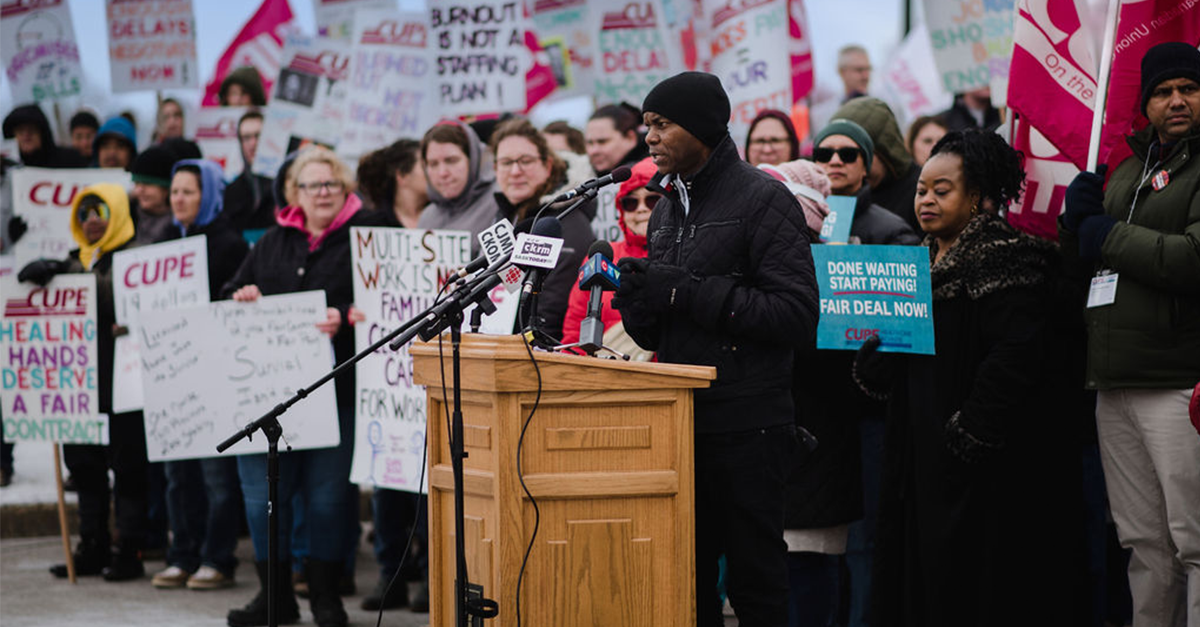
April 1, 2026 marks four full years since CUPE 5430 members last received a wage increase – an unfortunate milestone that underscores the urgency to reach a fair deal for Saskatchewan’s frontline health care workers.

For thousands of workers who keep the health care system running every day, this anniversary is no cause for celebration. It represents four years of rising costs, increased workloads, and deteriorating working conditions without any improvement in pay.

“It may be April Fools’ Day, but four years without a raise is no joke,” said Bashir Jalloh, president of CUPE 5430. “While the cost of living has skyrocketed, our members have been asked to do more with less – and for the same wages they received in 2022.”

“This isn’t just about fairness for workers – it’s about the future of Saskatchewan’s public health care system,” Jalloh added. “When health care workers feel undervalued and underpaid, they leave our health system. The status quo is bad for health workers, bad for patients and bad for Saskatchewan’s health care system.”

CUPE 5430 is calling on Premier Scott Moe and Health Minister Jeremy Cockrill to bring forward a decent offer to the bargaining table that reflects the critical role health workers play in Saskatchewan’s crumbling health care system.

After four years without a raise, the message from frontline workers is clear: enough is enough.

Airline industry appears to be flying the plane on federal government’s unpaid work probe

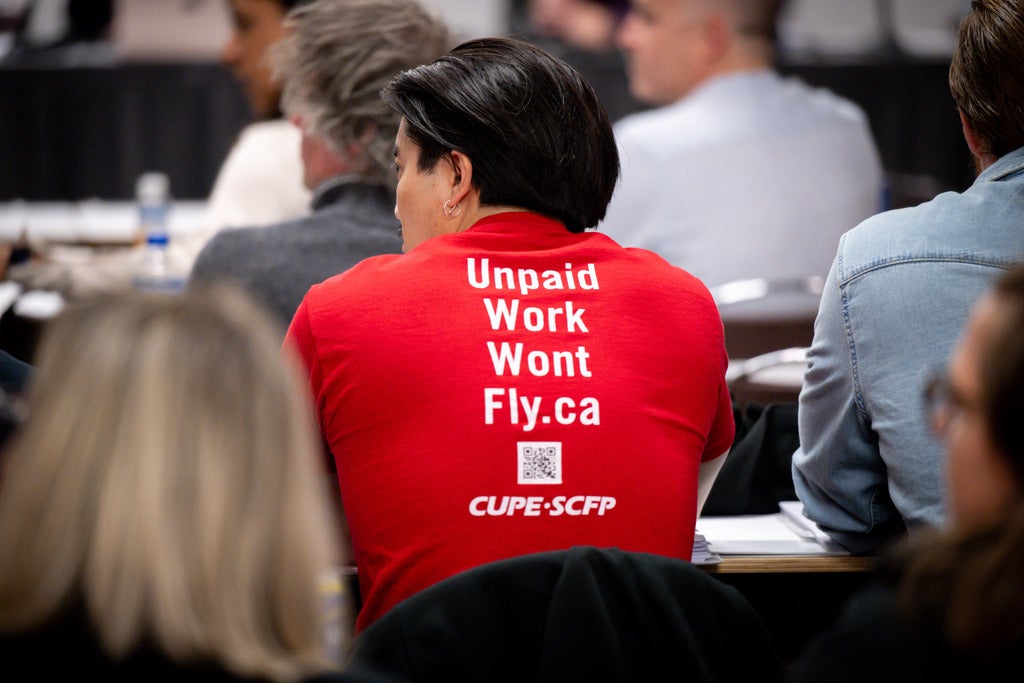
CUPE’s Airline Division, the union representing 20,000 flight attendants across Canada, is raising concerns about the impartiality and legitimacy of the federal government’s probe into unpaid work in the airline sector, as it enters its second phase.

“The parameters of this process have been noticeably tilted towards the industry position,” said Wesley Lesosky, President of the Airline Division of CUPE. “The government has done very little to avoid the impression that it’s actually the industry flying the plane.”

The first phase of the probe concluded with a request to airlines to perform minimum wage compliance self-audits. The federal government has recommended – but will not require – union participation in the audits.

“This is like asking drivers to report themselves for speeding,” said Lesosky. “This will seriously undermine confidence in the results.”

Other elements of the audit also raise additional concern:

  • There is no clear definition of what constitutes “hours of work” for flight attendants, which will allow airlines to pick and choose which duty hours are covered by wages, leaving the door open to a continuation of unpaid work.
  • The audit period arbitrarily excludes key peak travel months – including the Christmas holidays and March break – when storms, delays, and operational disruptions are at their highest. These are precisely the times when unpaid work pressures intensify.
  • The government is permitting extremely small and unrepresentative audit samples. Airlines with workforces as large as 10,500 flight attendants may audit as few as 40 employees pay records. The results of an audit so narrow will produce methodologically flawed and unreliable results.
  • No requirement for random sampling. Airlines may pick and choose who they audit, with no guarantee that workers facing the most serious unpaid work issues will be included.
  • Where violations are found, the corrective measures are not strong enough. The remedy for being caught underpaying employees should not be to pay minimum wage; it should be legislative and regulatory changes to guarantee that all hours are paid at the negotiated rate of pay.

“Flight attendants deserve to be paid for all hours worked, at their regular rate of pay,” said Lesosky. “This investigation should be an opportunity to fix a longstanding problem, not minimize it by helping the industry sweep it under the rug.”

CUPE’s Airline Division met with the federal government today, April 1, to register the union’s concerns and call on the government to correct course by strengthening the audit process to be robust and representative, and by listening to the voices of workers impacted – not just industry CEOs. The ball is now in the government’s court.

Halifax school library workers call on school board and regional councillors to protect school library programs

CUPE 5047 members—school librarians working in the Halifax Regional Centre for Education—keep literacy alive in our schools. They support students who are struggling, they create spaces where curiosity and belonging grow, and they make sure young people see themselves reflected in what they read.

The services our library staff provide are not optional. They are foundational. Right now, they are being treated as expendable.

Over the past few weeks, we have been watching a funding dispute unfold between City Council and the School Board, and in the middle of it are our members and the students they serve—being used as pawns in a political standoff. This is unacceptable.

The School Board must clearly and publicly affirm that school library programs will continue, and that the workers who deliver them will not lose their jobs.

City Councillors must ensure that stable, ongoing funding is in place so that these programs are not repeatedly thrown into uncertainty. Pulling the rug out from under essential services—and the people who provide them—is not responsible governance. It is a failure of leadership.

Our members deserve stability. Students deserve access to the resources that help them learn, grow, and succeed. And the public deserves institutions that act with clarity, accountability, and care.

We are calling on both the Halifax Regional Centre for Education and Halifax Regional Municipality City Councillors to do their jobs: protect these programs, protect these workers, and put students first.

Niagara Region paramedics deliver overwhelming strike mandate

In a sign of Niagaras deepening emergency services crisis, paramedics, dispatchers, and occupational therapists with CUPE 911 voted 99% in favour of strike action last week, with 82% of members voting.

The overwhelming strike mandate follows years of surging call volumes, falling response times for the most critical calls, limited staffing growth, and widespread burnout. Without action to improve recruitment and retention, including better mental health supports and pay parity, workers warn the system will continue to deteriorate.

This vote is about more than a contract. Its about whether Niagara Region residents can count on emergency care when they need it most,” said Dave Barnett, a paramedic with 16 years of experience and president of CUPE 911 representing roughly 470 workers. Niagara Region is underpaying paramedics and dispatchers, and it is resulting in our inability to get to the most critical patients with the appropriate resources.”

Response times are falling as system struggles to keep up

Data from Niagara EMS shows a steady erosion in response times for calls. Dispatchers are assigning ambulances slower than in previous years and paramedics are arriving later. This is of particular concern for cases of cardiac arrest where survival depends on rapid intervention.

In 2017, ambulances were assigned to cardiac arrest calls within two minutes, about 90% of the time. By 2024, that number cratered to 33%.

These are not abstract numbers, these are lives,” said Barnett. When response declines, survival rates can be affected. That should concern every resident in Niagara.”

Call volumes surge while staffing lags

Niagara EMS responded to more than 100,000 calls in 2024, an over 50% increase since 2020, while frontline staffing grew only modestly.

A persistent pay gap between first responders is making it difficult for the region to attract or keep paramedics. Primary Care Paramedics in Niagara earn 15 to 24% less than police and firefighters. While Niagara police get $20,000 a year in mental health support, paramedics receive just $3,000 despite high rates of PTSD. Looking elsewhere, Niagara paramedics earn substantially less than counterparts in Peel, Durham, Waterloo and other comparable regions.

Paramedics and dispatchers are one of the three pillars of emergency response, but were treated like an afterthought,” said Barnett. Parity with police and fire is not a luxury, its a necessity to stabilize the workforce.”

A 2025 CUPE 911 survey highlights the toll:

  • 60% say the job has negatively impacted their mental health
  • 44% have actively considered leaving Niagara EMS
  • Only 14% feel their mental health is supported by their employer
  • Only 11% feel their physical health is supported by their employer

Our members continue to show up every day under immense pressure,” said Barnett. Its time for Niagara Region to show up for us so we can keep residents safe.”

The two sides return to the table on May 13.

CUPE’s Year of Health and Safety

At CUPE’s National Convention in October 2025, members adopted a resolution declaring 2026 the Year of Health and Safety.

One focus of the Year of Health and Safety is strengthening health and safety committees. These committees play an important role in preventing injuries and protecting workers. They identify hazards, address risks and help ensure workers get home safe at the end of the day.

To support new and developing health and safety committees, CUPE has created a Health and Safety Committee Self-Evaluation Checklist. This tool helps worker representatives review core committee functions and identify areas for improvement. For established committees, CUPE has developed a new Health and Safety Committee Audit to assess health and safety programs in more detail.


CUPE has also released a new, plain-language booklet on health and safety committee basics for all members. The booklet outlines the role of health and safety committees, the role of the union and how members can get involved in this important work.

Throughout 2026, CUPE will host health and safety conferences across Canada. We will also be developing new ways for health and safety activists to connect, share updates and stay engaged.


Access our new health and safety resources and learn more at cupe.ca