Press "Enter" to skip to content

Posts published in October 2025

Workers at the Gilbert Centre have 100% strike vote

Frontline AIDS-service and harm reduction workers at the Gilbert Centre, in Barrie, Ontario, voted to strike after years of underfunding.  Every member cast a ballot—and every member voted yes.

The roughly members of CUPE 1813.14 run harm reduction programs, warming centres, outreach to drug users, and other critical programs that save lives. Many leave work and go to second jobs or food banks because they struggle to make ends meet.

They organized to join CUPE in 2022 when roughly 85% of members were precariously employed, going contract to contract. They fought—and won—stability. Now they are fighting to transform underpaid jobs at the Gilbert Centre into careers they can be proud of with fair wages and the stability of a pension.

“We love these jobs. We make a difference every single day. But we should not be punished with poverty for dedicating our lives to helping the most marginalized in our communities,” said Rebecca Madrid, president of CUPE 1813. “Social services in our city and our province are in crisis. Our neighbours cannot afford cuts or waitlists, and we cannot afford poverty wages that don’t invest in our future.”

The strike vote follows months of organizing through the Worth Fighting For campaign which unites thousands of CUPE and OPSEU members from more than 50 social services agencies across Ontario. The campaign demands fair wages and renewed investment in community services after years of neglect and the unconstitutional wage cap of Bill 124. While some public sector workers have been compensated for lost wages, Doug Ford’s Conservatives have ignored the workers who form the backbone of Ontario’s care economy.

“Ask parents of children on the autism waitlist or child protection workers who are forced to warehouse children in motels, and they’ll tell you that our social services are on the verge of collapse. This government has underfunded agencies and disregarded workers, hurting communities for years,” said Fred Hahn, President of CUPE Ontario. “That’s why we have waitlists and workers at food banks. We deserve a better Ontario, and these jobs, good services, and healthy communities are worth fighting for. The years of workers in social services quietly accepting whatever scraps the government hands out are over. We’re ready for a fight.”

Across Ontario, dozens of social service locals have taken or are preparing for strike votes, signaling growing frustration among frontline care workers and a coordinated demand for action.

Fraser Fort-George workers to begin rotating job action

CUPE 1699 workers issued 72-hour strike notice at 12:00 p.m. on Wednesday, October 15, 2025, which means the union will be in a legal position to begin rotating job action on Saturday afternoon. 

“Workers across the region deserve basic respect in the workplace,” said Daniel Burke, President of CUPE 1699, “they want the district to recognize the value of their work to keep our district running smoothly.”

The collective agreement with the regional district expired at the end of 2024, and the parties reached impasse in mediation in August 2025. Workers voted overwhelmingly in favour of strike action in late August. 

“Our members are just trying to afford the basic necessities in the communities they live in and serve every day,” says Burke. “This could be resolved immediately with a wage increase that is in line with the increase other municipal workers in the region have already negotiated.” 

Workers will be in a legal strike position as of 12:00 p.m. on Saturday, October 18, 2025. Details about which services and locations will be impacted, will be shared the morning job action begins. 

CUPE 1699 represents over 100 workers in the Regional District of Fraser Fort-George. These workers are responsible for district services like building inspection, land use, parks and recreation facilities, water systems, and solid waste management to communities in the region, including Prince George, District of Mackenzie, the Villages of McBride and Valemount, and 7 electoral areas. 

Locking out workers wrong choice for District of Squamish

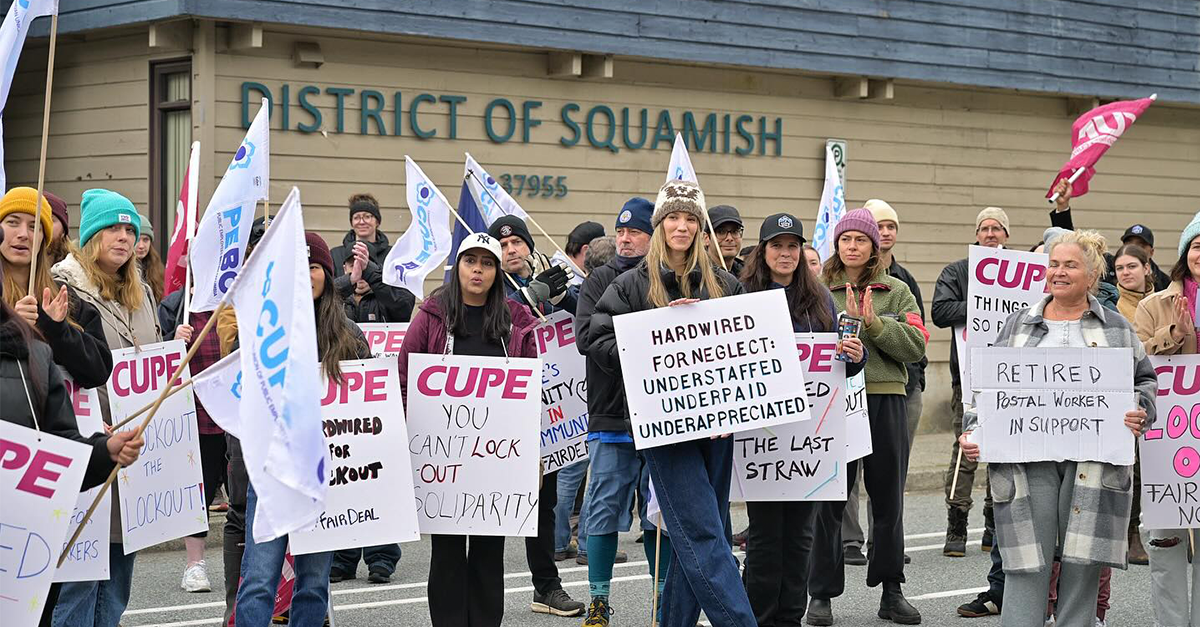
People standing with picket signs The District of Squamish in southern British Columbia has announced a lockout of its employees who deliver public services across the community. While the District refers to it as a “partial lockout,” the union representing workers says there is no such thing—a lockout is a lockout. As a result, once the lockout took effect at 6 a.m. this morning (Thursday, October 16), all services provided by CUPE 2269 members stopped, except those deemed essential as per the essential service order in place.

CUPE 2269 members represent approximately 250 workers who provide integral community services to residents, businesses, and visitors in Squamish including water and wastewater treatment, swimming lessons, children’s programs and camps, recreation services, facilities maintenance, parks and trails maintenance, bylaw and animal control, snow removal, emergency program administration, and administrative and operations support for the RCMP.

“This decision shows a lack of leadership,” said Celeste Bickford president of CUPE 2269. “The Mayor and Council, and senior management, have chosen escalation over resolution. Instead of doing the hard work needed to find a solution, they have chosen to lock out their own workers and indefinitely disrupt the public services that residents depend on every day”.

CUPE 2269 has engaged in limited job action since October 2 to reinforce that workers need a fair deal with competitive wages that address rising costs. The union says this will not just benefit workers but help the District recruit and retain the staff needed to deliver reliable public services.

Since 2024, approximately 40% of unionized workers have stopped working for the District of Squamish. And while the District has amended their exempt staff compensation policy to help address recruitment and retention concerns, they have not implemented a similar measure for unionized workers.

The union says the District choosing to lockout workers rather than engage in real dialogue harms both workers and the community, and does nothing to address the issues that caused this dispute.

“Let’s be clear, we never walked away from the table,” said Bickford. “When the District asked to resume negotiations earlier this month, we agreed in good faith. Instead of moving toward a deal, they came back with an offer that was lower than what they had previously proposed. Since our last bargaining date, the District has misrepresented what happened during negotiations and shared inaccurate information with the public.”

CUPE 2269 has always been ready to bargain and remains prepared to return to the table if the District is serious about reaching a fair deal that respects workers and protects the services Squamish residents rely on every day.

Working in an unsafe consumption site: A library perspective

It is impossible not to know there is an overdose crisis in Canada. You might think that no one is more aware of it than nurses, paramedics and social service workers – tens of thousands of whom are CUPE members.

But what fewer people realize is how deeply social and medical crises in Canada affect public libraries. With fewer public spaces that are truly open to the public, our libraries are becoming the only refuge left for many of our most vulnerable neighbours.

“I see libraries as a public good where we have a duty to provide services to those who are often abandoned by the state or kicked out of other public spaces,” says Kendra Cowley.

Cowley was a librarian at the Toronto Public Library in December 2024 when Ontario Premier Doug Ford brought in legislation forcing the closure of most supervised consumption sites in the province. These sites are closing despite an injunction, as the province withdrew funding for the services.

It was a move that put thousands of lives at risk, and pushed more drug use into dangerous, unsupervised spaces like libraries.

Cowley, who recently resigned from Toronto Public Library to take a job at a university library in Wyoming, sat on a library committee focused on providing services to vulnerable people when the provincial bill was announced. When the bill was raised in the committee, management said the issue was outside the committee’s mandate. Cowley and others disagreed and, together with library safety specialists who deal with drug poisonings daily, drafted an open letter.

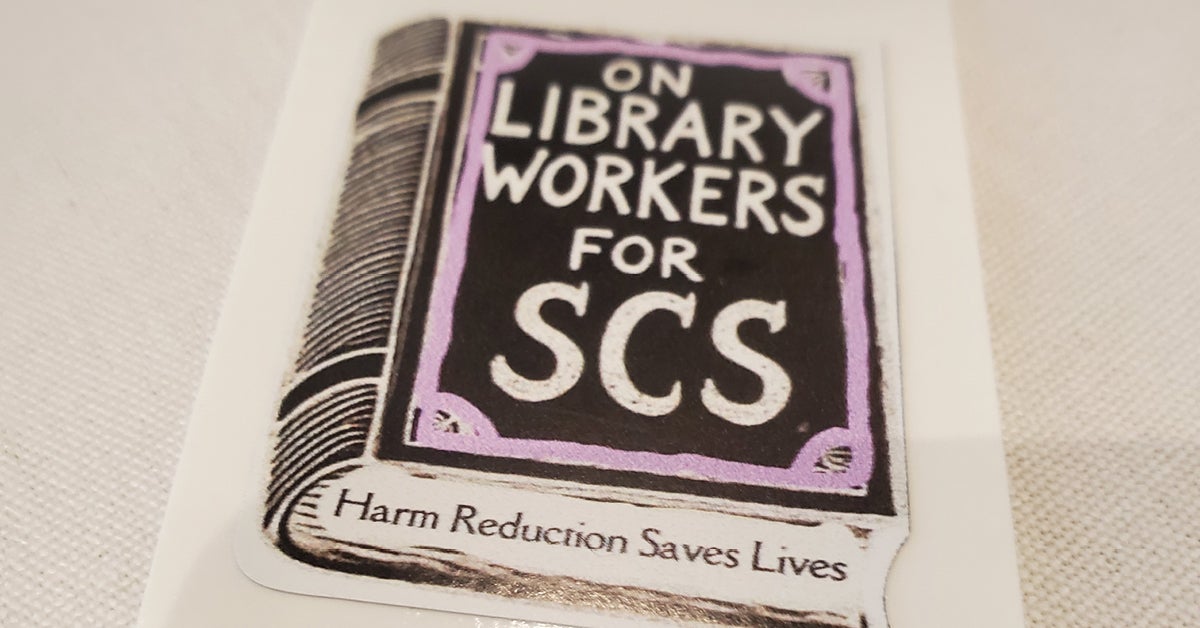
That letter quickly gathered hundreds of signatures and sparked a new grassroots movement: Ontario Library Workers for Supervised Consumption Sites (OLW4SCS).

The group – mainly library workers from large urban systems such as Toronto, Hamilton and London – launched a survey and a public advocacy campaign in support of the consumption sites that keep people they care about safe and help keep their workplaces safer.

The survey of 133 library workers in 16 cities found that more than 38% had responded to an overdose in the workplace, yet only half were trained well enough to feel confident in using naloxone – a medication that can reverse an overdose from opioids – and one-third did not know where to find it in their library branch.

Together, OLW4SCS played a significant advocacy role: providing important context for news stories, presenting to the CUPE Ontario Library Workers Caucus, and – at the Ontario Library Association’s invitation – staffing a booth at the OLA Super Conference. They also created a zine and resource site to help library workers have conversations in their workplaces and communities, something many had been craving.

“I saw what they posted on Instagram about starting this group and was really excited. I don’t have a lot of opportunities to share space and talk with people about this. We have so many shared experiences all across the province,” says Zoë Hayes, an information clerk at Hamilton Public Library and member of CUPE 932. “It feels like a success to have this network that allows us to share experiences and similarities because it can be so isolating. The survey we did was really helpful for that – to be able to say it’s not just happening here and there, but we’re all experiencing it in different places.”

Before becoming a library worker, Hayes was a counsellor and did harm reduction placements, including at South Riverdale Community Health Centre (SRCHC) in the east end of Toronto. SRCHC has a team of peer support workers who established the concept of street nursing. It also operated a supervised consumption site that CUPE Ontario campaigned to open. Later, in 2018, SRCHC staff organized into CUPE 5399.

Talking about compassionate treatment isn’t always easy for library workers. In recent years, as governments of all levels failed again and again to address the overlapping addiction, mental health and housing crises, library staff are left to contend with rising numbers of drug poisonings, disruptive patrons, and violent incidents.

While these problems are not new for libraries in major urban centres, they have become increasingly common in smaller cities, particularly in regional hubs like Peterborough, Kingston and Thunder Bay.

At the Thunder Bay library branch where a CUPE member was violently assaulted on the job in May, incidents rose by 183% over the past winter.

Most people living with addictions are neither violent nor disruptive – the spike in incidents reflects the multiple, overlapping social crises at play.

Unfortunately, the response of many libraries has been to hire security guards, or do nothing at all, to address the health and safety issues.

“One of the core conversations we needed to have as a group was, if we frame this as a health and safety issue, which it is, whose health are we talking about and whose safety are we talking about? To necessarily lump together a medical incident with violence doesn’t solve the problem,” says Cowley. “If we’re talking about safety, we need to prioritize the safety of the person who is in imminent threat of brain damage or death.”

Some library systems have been taking more innovative approaches. There are social workers in downtown branches of some urban library systems, for example.

Toronto Public Library has a pilot team of library safety specialists trained in de-escalation and drug poisoning response. But there are only 12 of them across the system’s 100 branches.

Hamilton Public Library partners with CAMH to provide peer support workers in its downtown branch. Peer support workers typically have a common background to the people they are supporting and are known in the community, so there is a level of trust others may lack, as one support worker explained at the CUPE Ontario Library Workers Caucus in April.

But again, it is a pilot project in one branch, not a system-wide strategy. Peer support workers don’t exist at the Barton branch where Hayes works – a part of Hamilton that has a large unhoused population.

“I’m so grateful for that peer support worker pilot at the central branch and for the social workers. I hope we can get them here too,” Hayes says.

Even that won’t fix everything. Solving the crises will require a concerted effort by all levels of government to increase affordable and supportive housing, expand mental health supports, and adopt real solutions to the overdose epidemic that killed more than 50,000 Canadians between 2016 and 2024, according to Health Canada.

“I’ve seen things escalate so much over time,” Hayes adds. “This winter was definitely the hardest and that was before the supervised consumption sites closed. I’m anticipating fallout. Winter is when we see the most health crises and challenges in the branch.” CUPE Ontario – an early, outspoken advocate for safe consumption sites and their workers – continues to campaign against the closures.

In June, OLW4SCS made deputations to the library boards in Hamilton and Toronto. They urged the boards to outline their plans for addressing Bill 233 and the drug-toxicity crisis, to ask front-line staff what they actually need – not more training, but time to recover from attending an incident – and to defend the right to public services that keep people safe.

At the end of the day, library workers are deeply compassionate, but few choose the profession expecting to handle overdoses or mental health crises.

What stands out is their remarkable desire for compassionate approaches, their appetite for new ideas but also their incredible need for more help.

Adequate staffing levels are at the core of both addressing health and safety concerns and attending to medical emergencies appropriately. Yet, right now, library workers are often working alone or in understaffed environments, expected to be at the desk, assist patrons, and run programs simultaneously.

“We can’t train ourselves out of a crisis,” Cowley says. “If I have to do all these other things, I can’t give my full attention to someone in medical distress.”

Connect with OLW4SCS at instagram.com/libraryworkers4scs

Opening doors to Indigenous representation in our unions

Ensuring that Indigenous members are included in union decision-making spaces is an important step on the path of reconciliation. One concrete way CUPE locals can do this is by creating an Indigenous workers’ representative position on their executive board.

This position is not simply a symbolic gesture. It ensures Indigenous members have an equal voice in all aspects of the local’s work — finances, bargaining, education, and beyond. It is not about assigning a single “Indigenous voice” to speak on certain issues, but about bringing a different lens to every decision. This also means the position must carry equal voting rights and responsibilities, just like any other member of the executive.

Each local’s path to creating this position will look different. Some may add a new seat to the executive, while others may adapt an existing one. If bylaw amendments are not yet in place to support that position, planning ahead, preparing draft language, and engaging Indigenous members and the membership at large in discussion well ahead of a vote will help to ensure participation and approval from the membership.

Adding an Indigenous workers’ representative is not about checking a box. It is one step along a longer path of reconciliation that also involves supporting Indigenous members’ participation in the union, recognizing the power imbalances that exist in colonial systems, and building relationships with Indigenous organizations and communities. It is about creating a culturally safe environment that is respectful and free from racism and discrimination — a space where Indigenous members can participate fully.

Ongoing education for all members is central to this work, and so are conversations. Indigenous members must be consulted throughout the process — on the duties of the position, the election process, and what meaningful participation looks like. At the same time, allies on the executive and in the broader membership need to take responsibility for explaining why the position matters and responding to concerns.

In that context, cultural humility is key. For non-Indigenous allies, that means recognizing their own biases, listening, approaching conversations as learners, and building respectful relationships based on trust. It means being realistic about where the local is at, and willing to start from a place of shared learning. While an Indigenous workers’ representative brings a unique perspective to the work of the union, the position should not be tokenized by only asking for input on issues related to reconciliation, by assigning them land acknowledgements or expecting them to act as teachers for others. Like all executive members, their contributions must be valued across the full scope of union leadership in shaping priorities that affect all members.

Creating an Indigenous workers’ representative position is not the end of the work. It is one piece of a larger commitment to reconciliation, where locals must continue to create opportunities for Indigenous members to be more engaged. Done thoughtfully, this step strengthens our entire union by making it more inclusive, more representative, and better equipped to fight for justice for all workers.

At the 2021 CUPE BC Convention, delegates adopted a resolution to encourage locals to add an Indigenous workers’ representative to their executive, recognizing the importance of representation of Indigenous members in our union. CUPE BC has since developed a guide to help locals through the process. Read their guide (in English only).