On Saturday, October 4, hundreds of education workers from across Ontario rallied at Queens Park to demand the Ford government take immediate action to address the growing crisis of violence in schools.
The Ontario government has cut billions from public education since 2018, creating a crisis in underfunding and understaffing at schools across the province. This has resulted in students no longer getting the supports they need from educations assistants, early childhood educators, child and youth workers, and other frontline education workers.
The rally was led by CUPE 1328, representing over 2,000 education workers across the Toronto Catholic District School Board (TCDSB), and speakers included CUPE Ontario President Fred Hahn, Ontario School Board Council of Unions President Joe Tigani, President of CUPE 1328 Sharron Flynn, ONDP MPPs Jessica Bell and Chris Glover and other education union presidents from across Ontario.
Sharron Flynn, president of CUPE 1328, said “we need to be way more proactive instead of reactive. They’ve cut massive funding for pre-emptive services. I worked as a Child and Youth Worker, and we used to intervene before situations became dangerous. That doesn’t exist anymore. Students are left without supports, and our members are left to put out fire after fire.”
A province-wide survey released earlier this year, conducted by the Ontario School Board Council of Unions (OSBCU) representing 57,000 education workers, paints a disturbing picture of the daily realities faced by education workers. Seventy-five percent of OSBCU members said they experience violent or disruptive incidents in their work. That number jumps to 96 percent for Educational Assistants and Child and Youth Workers, and 55 percent said they experience violence every day.
Students are frequently having their learning environments disrupted on a regular basis, which is not conducive to providing students with the highest quality of education they deserve.
CUPE 1328 and education workers across Ontario are demanding urgent investment in hiring thousands of additional frontline education workers to ensure every student has access to the supports they need and every worker can go to work without fear of violence.
Quotes:
Sharron Flynn, President of CUPE 1328: Our members at the Toronto Catholic District School Board are experiencing physical violence every single day, including biting, scratching, hair-pulling, and serious injuries because students are not given the supports that they need. Our local receives pictures of puncture wounds and ripped-out hair. Violent incidents are so frequent that many workers have stopped reporting them. This is not our students’ fault. They need so much more support than they’re currently getting in this system. We need to hire hundreds more education workers to get back to a safe baseline. And yet, members are being told that being hurt is ‘part of the job.’ No one should go to work and get hurt. It’s not accepted in any other profession — why is it the norm in education?
Fred Hahn, President of CUPE Ontario: Workers, parents and the public know that the biggest problem for education is provincial underfunding. The Ford Conservatives have tried to scapegoat trustees by putting the Toronto Catholic District School Board and three other boards under administration. But a recent Abacus Data poll commissioned by CUPE Ontario shows that people know problems like cuts, classroom violence and understaffing are caused by provincial underfunding. The crisis of violence in our schools won’t be fixed until there is more investment in the education workers in our schools: more educational assistants to support children with special needs; more custodians and maintenance workers to keep schools clean and safe; more child and youth workers to assist vulnerable students; in fact, more of all the people who support students’ education and make schools work.
Joe Tigani, President of OSBCU: Today education workers from across Ontario made it abundantly clear that the public education system is at a breaking point. For years, the Conservative government has continued to cut billions of dollars in funding to the education sector, causing extreme understaffing, increased violence against staff and students, and our students’ needs being neglected. There is no question that the Ford government has abandoned the education sector. The Ontario government must increase its investment in students and education workers and address this situation immediately. Students deserve better, parents deserve better, and our education workers deserve better.
Numbers at a Glance:
- According to an OSBCU province-wide survey, 75 percent of all respondents say they experience violent or disruptive incidents in their work area. 96 percent of Educational Assistants or Child and Youth Workers experience violent or disruptive incidents in their workplace, 55 percent say it happens every day.
- 74 percent of educational assistants and child and youth workers said they have their work areas evacuated, and 11 percent said it happens every day.
- 73 percent of EAs/CYWs support five or more students in a normal week. That is up from 60 percent who supported five or more students in a 2018 survey of CUPE EAs/CYWs, indicating a substantial increase in workload for staff and a serious decline in the direct support that can be given to students.
- 95 percent of respondents said there are students at the school(s) at which they work who need the support of an EA or CYW but who do not currently have EA or CYW support.
93 percent of EAs and CYWs reported that they sometimes have to choose between two (or more) students who need their immediate support at the same time. Large numbers of students are going without the supports they need in order to succeed (or even just to get through the day).

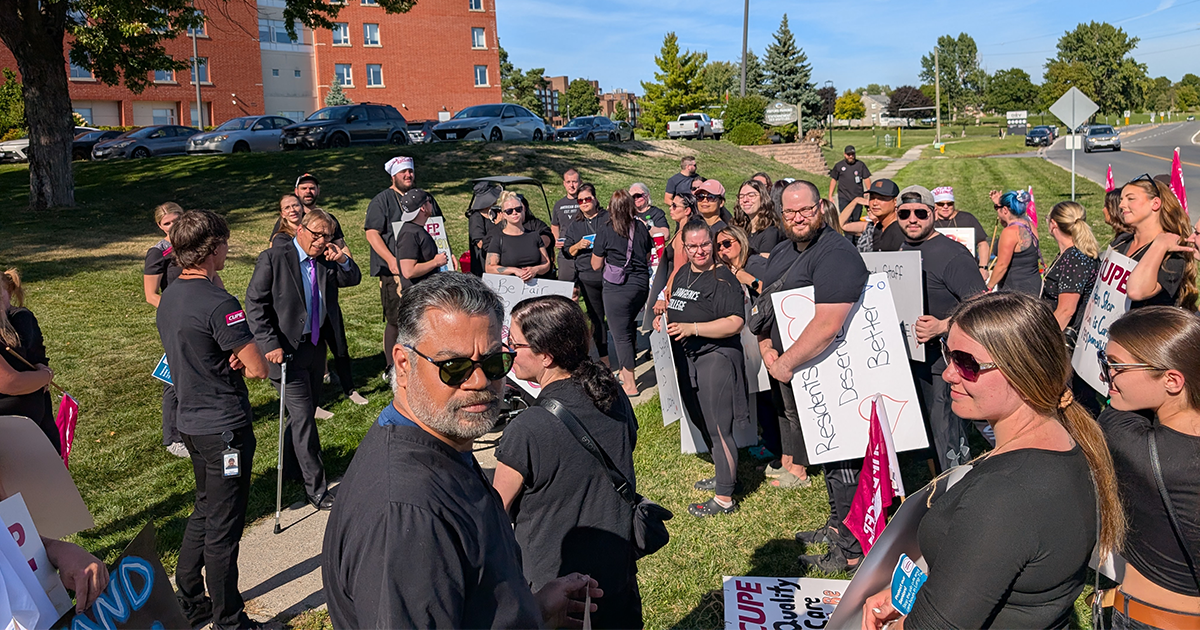 The union representing staff at Cornwall’s Glen Stor Dun Lodge, in southeaster Ontario, are holding another rally outside of City Hall this evening to keep pressure on city council to reverse the staffing cuts at the care home. The rally is the third action taken by the union to call public attention to the dangerous cuts to staff hours at the home which put the residents at risk.