
Press "Enter" to skip to content

Posts published in December 2025

New report finds immigrant women PSWs are subsidizing Ontario’s home care system with their unpaid labour

“I think it is really important for the government to invest in home care. There will be enough workers if you give us full-time jobs, decent wages, job security, value our work. There’ll be no shortage of PSWs.” – Connie Ndlovu, president of CUPE 7797.

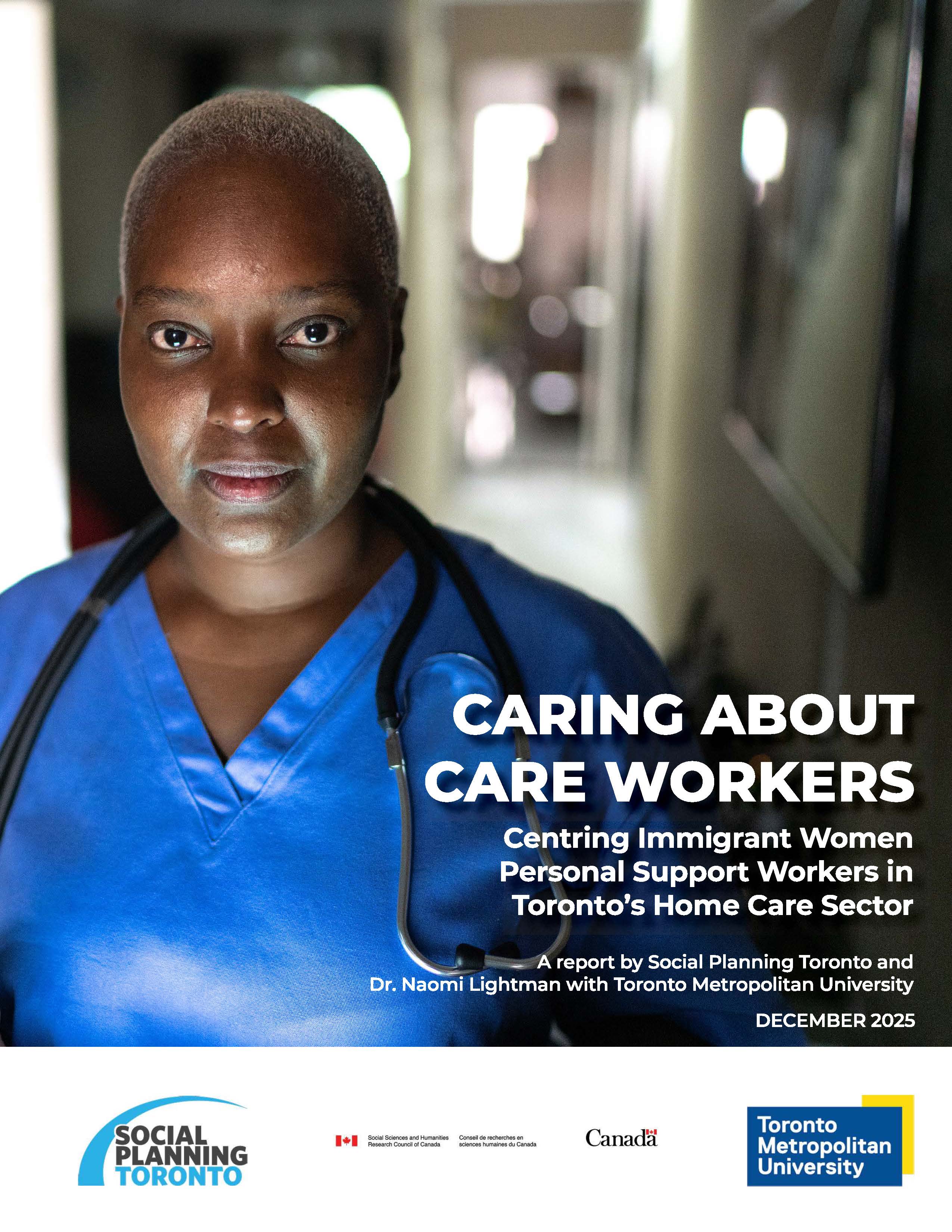
CUPE members’ perspectives helped shape a new report on home care, titled Caring about Care Workers: Centring Immigrant Women Personal Support Workers in Toronto’s Home Care Sector. The report was published by Social Planning Toronto.

Researchers found that personal support workers, PSWs, are subsidizing Ontario’s home care system with their unpaid labour. PSWs collectively provided 36.7 million hours of care to Ontarians in 2023-24 through the provincially-funded home care system. Their work supports home care recipients and their families, while also reducing pressure on hospitals, emergency departments, and long-term care homes. 

“We heard directly from personal support workers with unmanageable work schedules and inadequate paid time who want to provide clients with high-quality care” says Beth Wilson, a senior researcher and policy analyst at Social Planning Toronto, and one of the report’s authors. “They end up using their personal, unpaid time to compensate for the failures of the provincial home care system.”

PSWs described many problems with working in the home care sector, including lack of guaranteed work hours, inadequate and unreliable incomes, and insufficient (or no) reimbursement of travel time and costs despite being required to travel between client homes as part of their work. PSWs working in private homes (usually without onsite support) recounted numerous health and safety risks, including exposure to infectious disease, injuries due to the physically demanding nature of the work, unsafe and unsanitary conditions, and violence, harassment, and anti-Black racism. 

“The most vulnerable workers are providing the most essential services in the worst working conditions,” says Dr. Naomi Lightman, an Associate Professor at Toronto Metropolitan University and one of the report’s authors. “Going forward, we need an end to private profit in the publicly funded home care system to ensure that every public dollar supports high-quality care and good working conditions for home care workers.”

Low wages, precarious employment, and poor working conditions have been driving home care labour shortages, which will have grave consequences for Ontarians.

The report authors also conducted interviews with seven individuals engaged in labour and community organizing pertaining to PSWs and home care; one such interview is with community activist, home care PSW, and president of CUPE 7797 Connie Ndlovu.

“I think it is really important for the government to invest in home care,” says Connie. “There will be enough workers if you give us full-time jobs, decent wages, job security, value our work. There’ll be no shortage of PSWs.”

The report puts forward detailed recommendations for the Ontario and federal governments, home care service provider organizations, unions, and the community sector, aimed at ensuring fair and decent compensation and working conditions for home care PSWs.

Read the full report >> (English Only)

Tips to boost Indigenous, Black, and racialized members’ participation in local meetings

A strong and united CUPE means ensuring every voice is heard. A crucial part of that is inspiring and inviting equity-deserving members, like Indigenous, Black, and racialized members, to participate in local union meetings and activities. Keep reading to find out how you can boost the participation of these members in your local.

Here are some tips to consider:

  • Amplify the work already being done by Indigenous, Black, and racialized members. Find out which spaces Indigenous, Black, and racialized members are already involved in, such as local volunteer organizations or community groups, and see if there’s an opportunity to collaborate or amplify their work.
  • Show solidarity with members who are migrant workers. CUPE has more members with temporary work permits than ever before. With the 2024–2025 immigration changes, these CUPE members are facing challenges like even more precarious work status, expiring work permits, and risks of deportation. The Temporary foreign workers in our union: A solidarity and action guide suggests showing union solidarity with migrant workers in the local. Here are some tips:
    • Identify and address structural barriers, like language, in the local that prevent migrant workers from fully participating in the union. For example, offer collective agreement orientation sessions and consider translation services in the languages that migrant workers speak.
    • Create committees for migrant worker participation.
    • Organize events, such as inviting migrant worker organizations to host lunch-and-learns, celebrating significant cultural days, or holding a community barbecue.
    • Attend rallies, sign petitions, and participate in virtual or in-person events.
  • Host events for commemorative days or months. Organizing lunch-and-learns or events for commemorative days or months can increase participation of Indigenous, Black, or racialized workers. Locals can hold events to honour dates of cultural importance to their diverse members, such as Ramadan, Diwali, Kwanzaa, Yom Kippur, or the Lunar New Year.
  • Create an equity committee, such as a Racial Justice Committee or an Indigenous Council.
  • Add an equity or diversity seat to your local executive. When an Indigenous, Black or racialized member sees someone who looks like them and has similar lived experiences on the executive, they may feel more comfortable and be more motivated to engage in union activities. Check your bylaws to see what is needed to add a seat (example, a resolution, an amendment, advance notice, etc.).
  • Create a position within the local assigned to support Indigenous, Black, and racialized members. This position could be an Equity and Diversity Coordinator, an Equity and Diversity Chair, or a member at large assigned to support Indigenous, Black, and racialized members in the local. Members in these positions should be:
    • From one of these equity-deserving groups: Indigenous, 2SLGBTQI+, persons living with disabilities, Black or racialized, women or young workers (age 30 and under).
    • Able to engage equity-deserving members within the union and advise the executive board on topics concerning equity-deserving groups.
    • Able to organize the local and encourage committee participation in commemorative days or months such as Black History Month, International Women’s Day, Pride, Take Back the Night, and National Day for Truth and Reconciliation.
  • Send members from equity-deserving groups to the National Convention and human rights and equity conferences. Locals can send members from equity-deserving groups to the National Convention, using existing constitutional clauses such as article 6.4 of CUPE’s Constitution, as well as to regional and national human rights, women’s, and equity conferences.
  • Promote leadership development for Indigenous, Black, and racialized members. Open registration to Indigenous, Black and racialized members, track the progression of participants in leadership trainings, and amend book-off language to address equitable opportunities.
  • Collaborate with other unions’ equity or racial justice committees. Check the website of other unions for committees for human rights, workers of colour,
    anti-racism or Indigenous issues. Contact those committees to co-organize events, host joint meetings or other actions to strengthen solidarity among Indigenous, Black and racialized workers.

Resources

CUPE has a range of resources that can give your local ideas on how to increase participation and representation of Indigenous, Black, and racialized members in meetings and throughout your local.

Increasing participation of Indigenous, Black, and racialized members in your local can strengthen union solidarity, expand our pool of leaders and activists, and more.

Every member has a role to play in building an anti-racist CUPE. Check out the other tip sheets in this toolkit and learn more about how you can get involved in our union’s Anti-Racism Strategy: cupe.ca/antiracism.

Strike vote at the Longueuil housing office

CUPE 4887, the union representing outside workers at the Office d’habitation de Longueuil, unanimously voted in favour of pressure tactics that could go as far as an indefinite strike.

“In the midst of a housing crisis, we should be taking care of the people maintaining our affordable, non-market housing,” said CUPE representative Brigitte Archambault. 

Negotiations went well regarding non-monetary clauses. The sticking point arose over salary increases, which are set by the Société d’habitation du Québec, SHQ. For now, the SHQ can only commit to the percentages for the first three years, while the government is forcing all locals in the municipal sector to sign contracts for a minimum of five years.

“The employer is unable to give us the wage increase percentages for the final two years of the collective agreement. This situation is making our members feel extremely anxious and frustrated,” concluded the union representative. 

The collective agreement expired on December 31, 2024.

Illegal strike in Châteauguay: A heartfelt appeal by outside workers

Last Friday, the Tribunal administratif du travail ruled that the Ville de Châteauguay’s outside workers had held an illegal strike. The single-afternoon strike occurred several days ago. In a written statement signed by its executive committee, the union acknowledges the decision, but qualifies the strike as a symbolic gesture expressing the workers’ deep concern with the employer’s refusal to take part in actual labour relations.

The union would also like to set the record straight. Contrary to what the city is insinuating, the demonstration held during the municipal council meeting was not a “disruption.” The police forces at the scene confirmed that it was a peaceful demonstration. The Tribunal’s decision notes a single, first offence, namely a work stoppage for one afternoon.

Note that the union cancelled a week-long strike scheduled for November to avoid affecting the public and to give mediation a chance. In the meantime, the city has opted for confrontation: it refuses to discuss the matter in a labour relations committee meeting, unilaterally changes working conditions and demands major rollbacks without providing evidence for them.

“The story isn’t the strike itself,” reads the union’s written statement. “It is what is driving workers to take this action: the contempt of an employer who gives orders rather than being open to discussion. […] Instead of reaching out, the city is turning people against its municipal employees by misrepresenting our pressure tactics.”

The union reasserts its commitment to the public and hopes for a fair, respectful and fact-based agreement. The city is invited to return to the negotiating table in transparency and good faith.

For more information, the full statement from the union representing the Ville de Châteauguay’s outside workers is available online (in French).

Sherbrooke Heights strike deadline set in Peterborough amid employer threats

The union representing staff at Atira Retirement Canada’s Sherbrooke Heights, is preparing for a possible strike after a no-board report was issued by the labour board over the weekend. The 35 staff at the independent living facility in Peterborough, voted unanimously in favour of strike action after the employer failed to provide a wage offer that meets the pattern in the long-term care and retirement sector in Ontario.  

“Our members are working two or three jobs, just to survive,” said Heather Blackburn, president of CUPE 5129. “Our employer is making millions while paying us just barely above minimum wage. We love to support our residents, but we need to be able to support our families, too.”  

“Instead of negotiating with us after the strike vote, Atira sent our members threatening letters to our homes,” added Blackburn. “It’s shameful. We hope they will do better moving forward so we can focus on providing the best service to the residents instead of worrying about threats and intimidation.” 

With the no-board report issued, the countdown is now on for a possible strike on December 15th. The union is hopeful the employer will return to the table to negotiate a fair deal.